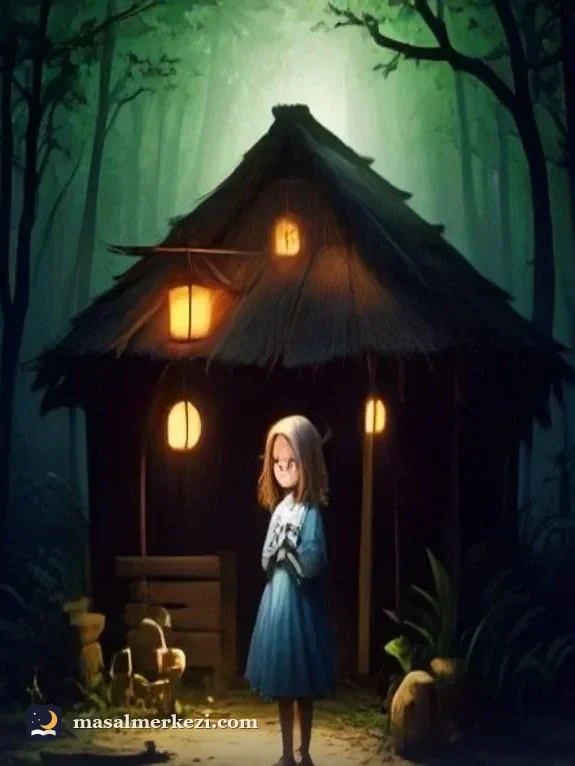
Baba Yaga and Vasilisa
Her stepmother sends Vasilisa to Baba Yaga for fire; a little wooden doll shows her the way.
Tap a word to see it in Turkish · Long press to translate the whole sentence.
Once upon a time there was a merchant. He had been married for twelve years and had only one daughter, Vasilisa the Beautiful. When the girl was eight years old, her mother fell ill. Before she died, she called her daughter to her, took a little wooden doll from under the blanket and gave it to her: "Listen, my little Vasilisa, and remember my last words. I am dying, and with my blessing I leave you this doll. Always keep it with you and show it to no one. If anything bad happens to you, give it something to eat and ask it for advice. When it has eaten, it will tell you how to escape." Her mother kissed her and died.
The merchant mourned for a while and then thought of marrying again. He married a widow who had two daughters. But the woman was cruel. Both the stepmother and the stepsisters were jealous of Vasilisa, because she was the most beautiful girl in the village. They made her do all the hard work, so that she would grow thin and be burned dark by the sun. But Vasilisa did everything without complaining and grew more beautiful every day. The three cruel women, who sat idle and thought only of mischief, grew thin and ugly. The reason was the doll. Every night, when everyone was asleep, Vasilisa gave the doll a piece of her supper, saying, "Eat, little doll, and listen to my troubles," and told it all her sorrows. The doll ate the food and gave her comfort and advice, and in the morning she found all her work already done.
The years passed, Vasilisa grew up, and the young men of the village wanted to marry her. The stepmother was furious. One day the merchant had to go on a long journey. At once the stepmother moved to another house at the edge of the forest. Deep in that forest lived Baba Yaga. Baba Yaga was a terrible witch who lived in a hut on chicken legs and ate people as if they were chickens. The stepmother often sent Vasilisa into the forest, but each time Vasilisa came back safely, thanks to the doll.
In autumn the stepmother gave all three girls work to do in the evening: one was to make lace, one to knit stockings, and Vasilisa to spin wool. She put out every light in the house, leaving only a single candle where the girls were working, and went to bed. The girls worked. When the candle wick grew dark, one of the stepsisters pretended to trim it and put it out as if by accident. "What shall we do now?" said the girls. "There's no fire in the house, and we haven't finished our work. Someone must fetch fire from Baba Yaga." "My pins give me enough light," said the one making lace. "I won't go either. My needles shine," said the one knitting stockings. "You must go!" they both shouted at Vasilisa, and they pushed her out of the door.
Vasilisa went to her room and set food before the doll: "Eat, little doll, and listen to my troubles. They're sending me to Baba Yaga for fire. Baba Yaga will eat me." The doll ate the food, and its eyes shone like two candles: "Don't be afraid, little Vasilisa. Go where they send you, but always keep me with you. While I'm with you, Baba Yaga can do you no harm." Vasilisa put the doll in her pocket, crossed herself and went into the dark forest.
As she walked, she trembled. Suddenly a horseman galloped past her: his face was white, his clothes were white, his horse was white and its harness was white. And day began to dawn. She walked on a little further, and another horseman galloped past: his face was red, his clothes were red and his horse was red. And the sun rose. She walked all day, and towards evening she came to the clearing where Baba Yaga's hut stood. The fence around the hut was made of human bones, and on top of the fence were skulls with glowing eyes. The hinges of the gate were human feet, and the lock was a mouth with sharp teeth. Vasilisa froze with fear. Suddenly another horseman rode past: his face was black, his clothes were black and his horse was black. He rode up to the gate of the hut and vanished into the ground, and night fell. But the darkness did not last long; the eyes of the skulls on the fence lit up, and the clearing became as bright as day.
As Vasilisa stood trembling with fear, a terrible noise came from the forest; the trees creaked and the dry leaves rustled. Baba Yaga came flying in a mortar, driving it along with a pestle and sweeping away her tracks with a broom. When she reached the gate, she stopped, sniffed and cried: "Phoo, phoo! I smell a human! Who's there?" Vasilisa came forward fearfully and bowed low: "It's me, Grandmother. My stepsisters sent me to you for fire." "Very well," said Baba Yaga. "I know them. If you stay and work for me for a while, I'll give you fire. If you don't, I'll eat you!"
Then she turned to the gate: "My strong locks, open! My wide gate, open!" The gate opened, and Baba Yaga went in whistling, and Vasilisa followed her, and the gate locked again. Baba Yaga sat down at the table and said to Vasilisa: "Bring me whatever is in the oven. I'm hungry." Vasilisa lit a splinter from one of the skulls on the fence and began to carry food from the oven to Baba Yaga, enough food for ten people. She brought wine and honey from the cellar. Baba Yaga ate and drank it all; she left Vasilisa only a little soup, a crust of bread and a scrap of pork.
As she got ready for bed, Baba Yaga said: "Tomorrow, when I've gone, sweep the yard, clean the hut, cook the supper and wash the laundry. Then go to the granary, take a quarter of wheat, and pick out all the black grains. If you don't do it all, I'll eat you!" And she began to snore. Vasilisa set Baba Yaga's leftovers before her doll and wept: "Eat, little doll, and listen to my troubles. Baba Yaga has given me very hard work. If I can't do it, she'll eat me. Help me!" The doll said: "Don't be afraid, Vasilisa the Beautiful. Eat your supper, say your prayers and go to sleep. The morning is wiser than the evening."
Early in the morning Vasilisa woke; Baba Yaga was already up and looking out of the window. The eyes of the skulls had gone out. The white horseman rode by, and day dawned. Baba Yaga went outside and whistled, and her mortar, pestle and broom appeared before her. The red horseman rode by, and the sun rose. Baba Yaga climbed into her mortar and flew away. Vasilisa was left alone in the hut. As she was wondering what to do, she saw that all the work had been done: the yard was swept, the hut was clean, the wheat was picked clean of black grains. The doll was just picking out the last black grain. "Oh, my saviour," said Vasilisa, "you've saved me from disaster!" "You only have to cook the supper," said the doll, and it slipped back into Vasilisa's pocket.
When evening came, Baba Yaga returned: "Is everything done?" "Look for yourself, Grandmother." Baba Yaga looked at everything, and when she could find nothing to be angry about, she was very annoyed. "Very well," she said, and called out: "My faithful servants, my dear friends, grind my wheat!" Three pairs of hands appeared, took the wheat and vanished. The next day Baba Yaga gave her the same work again, and also told her to pick poppy seeds out of the earth in the granary one by one. And again the doll did all the work.
In the evening, while Baba Yaga was eating, Vasilisa stood silently beside her. "Why don't you speak?" said Baba Yaga. "You stand there as if you were dumb." "If you'll allow me, I'd like to ask you something," said Vasilisa. "Ask, but not every question is a good one. Whoever knows too much grows old too soon." "I only want to ask about what I've seen, Grandmother. On my way to you, a white horseman on a white horse passed me. Who was he?" "He is my bright day," said Baba Yaga. "Then a red horseman passed me. Who was he?" "He is my red sun." "Then a black horseman passed me and came to your gate. Who was he, Grandmother?" "He is my dark night. All three are my faithful servants."
Vasilisa thought of the three pairs of hands but did not ask. "Why don't you ask anything else?" said Baba Yaga. "That's enough, Grandmother. You said yourself, whoever knows too much grows old too soon." "You did well," said Baba Yaga, "to ask only about what you saw outside the hut, not what you saw inside. I don't like the secrets of my hut being carried outside, and I eat those who are too curious. Now I'll ask you something: how did you finish the work I gave you so quickly?" "My mother's blessing helps me," said Vasilisa.
"So that's it!" cried Baba Yaga. "Get out of my house, you blessed girl! I won't have anyone blessed in my house!" She dragged Vasilisa out of the room, pushed her out of the gate, took a skull with burning eyes from the fence, stuck it on a stick and gave it to Vasilisa: "Here's fire for your stepsisters. Take it. Isn't that what they sent you here for?"
Vasilisa ran through the forest by the light of the skull. By morning she had found the path, and by evening she reached her home. When she came to the gate, she wanted to throw away the skull, thinking, "They surely don't need fire any more." But a voice came from the skull: "Don't throw me away. Take me to your stepmother." Vasilisa looked at her stepmother's house; there was no light in any window, so she decided to take the skull inside. For the first time they greeted her kindly, because there had been no fire in the house since she left. However hard they had tried, they had not been able to light a fire, and the fire they brought from the neighbours went out as soon as it came into the room.
"Perhaps your fire won't go out," said the stepmother. They took the skull into the parlour. The skull's eyes fixed on the stepmother and her two daughters and began to burn them like fire. They tried to run and hide, but wherever they ran, the skull's eyes followed them. Until morning they ran about in fear; when morning came, they fled from the house, taking their wickedness with them, and they never came back. Vasilisa buried the skull in the garden, and no one ever saw it again.
Vasilisa went to the town and found shelter with a lonely old woman, and waited there for her father to come home. She had the old woman bring her flax and began to spin. With the doll's help she spun thread so fine and beautiful that it was like a hair. Then the doll made her a loom in a single night, and all winter Vasilisa wove linen so fine that it could be passed through the eye of a needle. In the spring the old woman took the linen to the tsar.
The tsar was amazed by the cloth: "Who wove this?" The old woman told him about Vasilisa. The tsar wanted shirts made from the cloth, but no tailor dared to cut such fine linen. The tsar sent for Vasilisa. Vasilisa sewed the shirts and took them to the palace herself. When the tsar saw Vasilisa the Beautiful, he fell in love with her: "Vasilisa the Beautiful, I won't let you go. You shall be my wife." And he married her.
Soon afterwards Vasilisa's father came back from his journey. When he heard what had happened to his daughter, he was overjoyed, and he went to live with her in the palace. They took the old woman into the palace too. And the wooden doll stayed in Vasilisa's pocket for the rest of her life. For a mother's love walks beside us even in the darkest forest.
The tale ends here. Sleep well.
Baba Yaga and Vasilisa is a children's tale from Russian folk tale, suitable for ages 6-11 and about 11 minutes long. Read it free on Masal Merkezi, play a lullaby or nature sound in the background, tap any word to see its Turkish meaning and save it to your favorites. For similar tales browse the Classic Tales category.
Sign up and your favorites and reading list follow you on every device.