Basat and Tepegoz
Basat, raised among lions, saves the Oghuz land from the one-eyed giant Tepegoz.
Tap a word to see it in Turkish · Long press to translate the whole sentence.
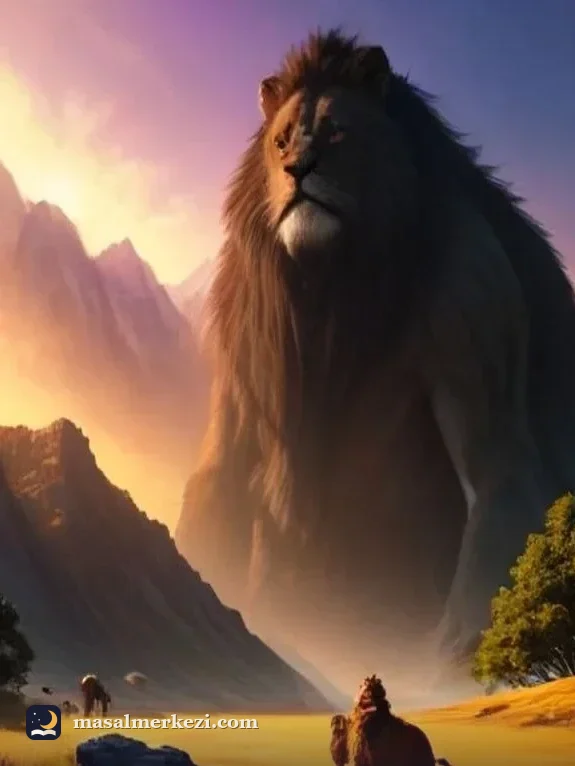
Once, as the Oghuz tribes were moving up to their summer pastures, they were attacked by enemies. In the darkness of the night, as everyone fled, the little son of Aruz Koja fell from his horse and was left behind. A lion in the forest found him but did not eat him; on the contrary, it raised him like its own cub. The boy grew up among the lions and became as strong and fearless as they were; even horses were frightened when they saw him on the road.
Years later an Oghuz horseman saw this boy in the forest and told Aruz Koja. Aruz Koja went to the forest, recognised his son and brought him home. But the boy did not want to stay at home; he kept trying to run back to the lions. Dede Korkut came and said to the boy: "Boy, you are a human; don't keep company with animals. Come, mount a horse and ride with the warriors." And he gave him his name: "Let your name be Basat. I have given you your name; may God give you long life." Little by little Basat grew used to living among people and became one of the bravest young men of the Oghuz.
Another time, as the Oghuz were moving to the summer pastures, Aruz Koja's shepherd saw fairy maidens sitting by a spring. The shepherd caught one of the maidens, but as the fairy flew away from him she said: "Shepherd, come back in a year. I'll have something that belongs to you. But you have brought disaster upon the Oghuz." A year later a strange creature was found by that spring. It had only one eye, and the eye was on the top of its head. They named it Tepegoz, which means Eye-on-Top.
Aruz Koja took Tepegoz into his home and raised him together with his own son Basat. But as Tepegoz grew, he became terrible. When he played with the children, he would tear off their ears and noses. In the end the Oghuz lords gathered and drove him out of the plain. Tepegoz withdrew into the mountains, settled in a cave and began to waylay travellers and harm people. His fairy mother came and put a ring on his finger: "My son, may no arrow pierce you and no sword cut you." That is why no weapon could harm Tepegoz.
Tepegoz brought ruin upon the Oghuz. The Oghuz warriors stood against him, but none of them could defeat him. At last the Oghuz lords sent Dede Korkut to Tepegoz as an envoy. Dede Korkut made an agreement with him: every day the Oghuz would give him two men and five hundred sheep, and he would harm no one else. The Oghuz began to pay this heavy tribute. When each family's turn came, laments rose from the tents.
One day the turn came to a mother who had two sons. She had already given one, and now she had to give the other. Weeping, the mother came to Basat, who had just returned to the pastures: "Basat, I had two sons. I gave one to Tepegoz, and now he wants the other. Help me." Basat's eyes filled with tears, for his own elder brother, Kiyan Seljuk, had fallen fighting Tepegoz. He went to his mother and father and said: "I'm going to fight Tepegoz."
His father, Aruz Koja, wept: "My son, your brother is gone. If you go too, what shall I do?" But Basat was determined. Dede Korkut said to him, "My brave one, no arrow pierces Tepegoz and no sword cuts him. You can only defeat him with your wits." Basat took his arrows, his bow and his sword, received the blessing of his mother and father, and set out for Tepegoz's mountain.
When he came near Tepegoz's cave, he saw Tepegoz lying with his back to the sun. Basat shot an arrow; it struck Tepegoz's chest and broke. "These flies are bothering us," said Tepegoz. He shot another arrow, and it broke too. The third arrow did the same. Tepegoz got up and saw Basat; he grabbed him with one hand, stuffed him into the top of his boot and carried him to his cave. "I'll put this one on a spit and eat him tomorrow," he told his servants, and he went to sleep.
Basat cut through the leather of the boot with his knife and climbed out. He asked Tepegoz's servants: "Where does his death lie?" "We don't know," said the servants. "No weapon can harm any part of his body. Only his eye is flesh." Basat heated a spit in the fire until it glowed red, and he drove it into the single eye of the sleeping Tepegoz. Tepegoz gave such a roar that the mountains and rocks echoed. Basat at once ran in among the sheep in the cave.
Blinded, Tepegoz sat down at the mouth of the cave with his two feet on either side of the entrance: "Rams, come and pass out one by one." He let the sheep out one by one, stroking each of them on the head, so that he could catch Basat. Basat killed a ram, put on its fleece and mingled with the rams. When Tepegoz touched his head, he said, "Ah, my dear ram's head! If only you knew who blinded me, you'd dash him from rock to rock." Inside the ram's fleece, Basat passed out through the mouth of the cave. When he was outside, he threw off the fleece and shouted: "Here I am! It was I who blinded you, Basat, son of Aruz!"
Tepegoz laid traps for him. "Basat, have you escaped? Take this ring and put it on your finger, so that no arrow pierces you and no sword cuts you." Basat put on the ring, but when Tepegoz tried to stab him with a dagger, the ring slipped off Basat's finger and fell at Tepegoz's feet. Then Tepegoz sent him into a domed treasure house, but the dome began to collapse on top of Basat. Basat prayed, "Lord, protect me," and the seven doors of the dome opened, and Basat escaped.
At last Basat asked Tepegoz: "Where does your death lie?" Tepegoz knew now that his death had come: "There is a sword inside the cave. My death lies in that sword." Basat went into the cave and saw that the sword hung from a chain and kept rising and falling. He shot an arrow and brought the sword down from its chain, picked it up when it fell and came back to Tepegoz. Tepegoz begged, but Basat said, "You are the one who made the mothers of the Oghuz weep," and with the sword he put an end to him.
Basat sent a messenger to bring the Oghuz the good news that Tepegoz was dead. All the Oghuz rejoiced at the news. Mothers of daughters, mothers of sons and weeping old men shed tears of joy. When Basat returned home, Kazan Khan and all the Oghuz lords came to meet him. Dede Korkut came, played his kopuz, sang an epic of Basat's heroism, and prayed: "May your black mountains never crumble, may your shady tree never be cut down, may your beautiful flowing waters never dry up. May your white-haired mother's place be paradise, and your white-bearded father's place be heaven."
This story tells us: true heroism lies not only in strength, but in wits and in the heart. Basat defeated Tepegoz, whom neither arrow nor sword could harm, with his wits, and wiped away the tears of the Oghuz mothers.
The tale ends here. Sleep well.
Basat and Tepegoz is a children's tale from Dede Korkut, suitable for ages 7-12 and about 7 minutes long. Read it free on Masal Merkezi, play a lullaby or nature sound in the background, tap any word to see its Turkish meaning and save it to your favorites. For similar tales browse the Turkish Folk Tales category.
Sign up and your favorites and reading list follow you on every device.