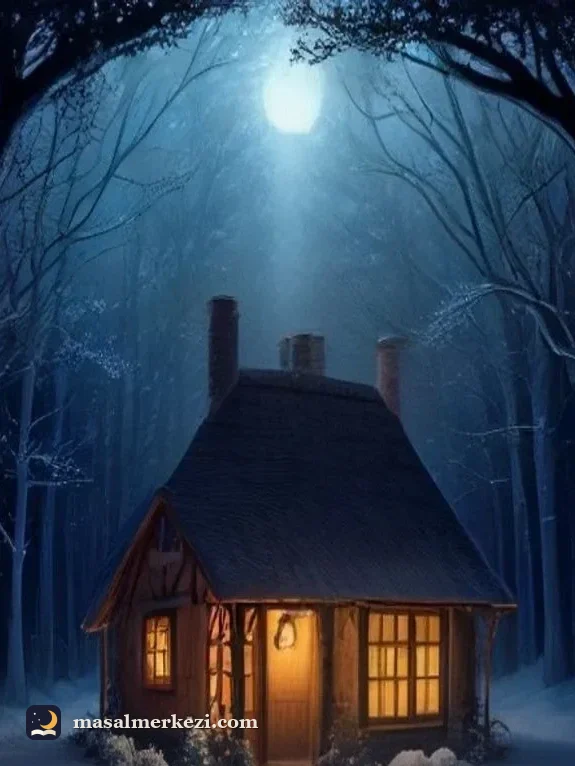
Hansel and Gretel
Two children lost in the forest find a house made of sweets. But its owner is not sweet at all.
Tap a word to see it in Turkish · Long press to translate the whole sentence.
At the edge of a great forest there lived a poor woodcutter with his wife and two children. The boy was called Hansel and the girl Gretel. There was never much to eat in the house. One year a great famine came over the land, and the woodcutter could no longer even find their daily bread.
One night, as he lay tossing and turning in bed, he sighed and said to his wife: "What will become of us? How can we feed our poor children when we don't even have enough for ourselves?" His wife, who was the children's stepmother, said, "Listen to me. Early tomorrow morning we'll take the children into the thickest part of the forest. We'll light them a fire and give each of them a piece of bread, and then we'll go off to our work and leave them there. They won't find their way home, and we'll be rid of them." "No, wife, I can't do that," said the woodcutter. "How could I leave my children alone in the forest? The wild animals would come and tear them to pieces." But the woman nagged and nagged until at last the woodcutter, against his will, gave in.
The two children could not sleep for hunger either, and they had heard what their stepmother said to their father. Gretel wept bitterly: "What shall we do now?" "Hush, Gretel, don't worry. I'll find a way," said Hansel. When their parents were asleep, he got up, put on his little coat, opened the door and slipped outside. The moon was shining brightly, and the white pebbles in front of the house glittered like silver coins. Hansel bent down and filled his pockets with pebbles. Then he went back in and said to Gretel, "Don't be afraid, little sister. Go to sleep. God will not abandon us."
In the morning, before the sun had even risen, the stepmother came and woke the children: "Get up, you lazybones, we're going into the forest to fetch wood." She gave each of them a piece of bread. They all set off together for the forest. On the way, Hansel kept stopping and looking back. "Hansel, what are you looking at, lagging behind like that?" asked his father. "I'm looking at my little white cat on the roof, Father. It wants to say goodbye to me," said Hansel. But really, every time he stopped, he took a white pebble from his pocket and dropped it on the path.
When they reached the middle of the forest, the father built a fire for the children. "Lie down by the fire, children," said the stepmother. "We'll be cutting wood a little way off. When we've finished, we'll come back for you." Hansel and Gretel sat by the fire, and at noon they ate their bread. Because they could hear the sound of an axe, they thought their father was nearby. But it was not an axe; it was a branch their father had tied to a dead tree, and the wind was knocking it back and forth. They waited for a long time, their eyes closed with tiredness, and they fell fast asleep.
When they woke up, it was night. Gretel began to cry: "How will we get out of the forest?" Hansel comforted her: "Wait a little until the moon rises, and we'll find the way." When the full moon rose, Hansel took his sister by the hand, and they walked all night, following the pebbles, which shone like newly minted coins. Towards dawn they reached their father's house. They knocked at the door. When the stepmother opened it and saw them, she said, "You naughty children, why did you sleep so long in the forest? We thought you were never coming back." But their father was overjoyed, for it had broken his heart to leave them in the forest.
Some time later, famine spread everywhere again. One night the children heard their stepmother saying the same thing to their father: "Everything is gone again. We have half a loaf left. This time we must take the children deeper into the forest." Hansel got up to gather pebbles again, but the stepmother had locked the door. Still, Hansel comforted his sister: "Don't cry, Gretel. Go to sleep. God will help us."
In the morning the stepmother gave the children a piece of bread, even smaller than the last one. On the way Hansel crumbled his bread in his pocket and, stopping often, dropped the crumbs on the path. The stepmother led the children deeper into the forest than they had ever been before. Again a fire was lit, and again they were left alone. At noon Gretel shared her bread with Hansel, because he had scattered his on the path. Evening came, and no one came to fetch them.
When the moon rose, they wanted to set off, but they could not find the breadcrumbs; the thousands of birds that fly about the forest and fields had eaten them all. "We'll find the way," said Hansel, but they could not find it. They walked all night and the whole of the next day from morning to evening, but they could not get out of the forest. They were very hungry; they found nothing to eat but a few berries on the ground. They were so tired that they lay down under a tree and fell asleep.
Three days had passed since they left their father's house. They began walking again, but only went deeper into the forest. At noon they saw a beautiful snow-white bird sitting on a branch. It sang so sweetly that they stopped to listen. Then the bird spread its wings and flew ahead of them, and they followed it. The bird landed on the roof of a little house. As the children came closer, they saw that the house was made of bread, the roof was covered with cake, and the windows were made of sugar.
"Come on, Gretel, let's have a good meal," said Hansel. "I'll eat a piece of the roof, and you can eat from the window; it's sweet." Hansel broke off a piece of the roof, and Gretel leaned against the window and nibbled at it. Then a thin voice came from inside: "Nibble, nibble, little mouse, who is nibbling at my house?" "The wind, the wind, the heavenly wind," answered the children, and they went on eating.
Suddenly the door opened, and a very old woman leaning on a crutch came out. Hansel and Gretel were so frightened that they dropped what they were holding. But the old woman nodded her head and said, "Oh, dear children, who brought you here? Come inside and stay with me. No harm will come to you." She took them inside and put milk, pancakes with sugar, apples and nuts on the table. Then she made up two lovely little beds. Hansel and Gretel lay down in them and thought they were in heaven.
But the old woman was really a wicked witch who only pretended to be kind. She had built the sweet house to lure children. Witches have red eyes and cannot see far, but they have a keen sense of smell, like animals, and know when people are near. Early in the morning the witch got up, saw how sweetly the children were sleeping, and muttered to herself: "They will make a fine feast for me."
She seized Hansel with her bony hand, carried him to a little shed and locked him in behind a barred door. However much Hansel screamed, it did no good. Then she shook Gretel awake: "Get up, lazybones! Fetch water and cook something good for your brother. He's in the shed outside and must be fattened up. When he's fat, I'm going to eat him." Gretel wept bitterly, but it was no use; she had to do what the wicked witch said.
The best food was cooked for poor Hansel, but Gretel got nothing but crab shells. Every morning the witch went to the shed and said, "Hansel, stick out your finger so I can feel if you're getting fat." But Hansel held out a little bone instead. The witch, whose eyes were weak, thought it was Hansel's finger and wondered why he was not getting any fatter.
Four weeks went by, and Hansel still seemed thin. The witch lost her patience. "Gretel, quick, fetch water! Fat or thin, tomorrow I'll cook Hansel." As the poor girl carried the water, tears ran down her cheeks. "If only the wild animals in the forest had eaten us, at least we would have died together," she cried.
Early in the morning the witch said to Gretel, "First we'll bake bread. I've heated the oven and kneaded the dough." She pushed poor Gretel towards the oven, where the flames were blazing: "Climb in and see if it's hot enough for us to put the bread in." The witch meant to shut the oven door once Gretel was inside and cook her too. But Gretel saw what she was up to: "I don't know how to do it. How do I get in?" "Silly goose," said the witch, "the opening is big enough. Look, even I could get in." The witch stuck her head into the oven. At that moment Gretel pushed her with all her might, slammed the iron door shut and bolted it. The witch began to shriek inside, but Gretel ran away, and the wicked witch was gone forever.
Gretel ran straight to Hansel, opened the door of the shed and cried: "Hansel, we're saved! The old witch is gone!" Hansel sprang out like a bird from a cage when its door is opened. They hugged each other, jumped about with joy and kissed. Since there was nothing more to fear, they went into the witch's house. In every corner there were chests full of pearls and jewels. Hansel filled his pockets, and Gretel filled her apron.
"Now let's go, and get out of this enchanted forest," said Hansel. After walking for a few hours, they came to a wide stretch of water. There was no bridge and no boat. "Look, there's a white duck swimming over there. If I ask her, she'll help us across," said Gretel, and she called: "Little duck, little duck, Hansel and Gretel are waiting here. There's no bridge and no boat; carry us on your white back." The duck came. Hansel sat on her back and told his sister to sit beside him. "No," said Gretel, "we'd be too heavy for the duck. Let her carry us across one at a time." And the kind duck carried them both across, one after the other.
After walking a little further, the forest began to look more and more familiar. At last they saw their father's house in the distance. They began to run, burst into the house and threw their arms around their father's neck. Their father had not had a single happy moment since he left his children in the forest, and meanwhile the stepmother had died. Gretel shook out her apron, and pearls and precious stones scattered across the room, and Hansel took handful after handful of jewels from his pockets. Now all their troubles were over, and they lived together happily ever after.
The tale ends here. Sleep well.
Hansel and Gretel is a children's tale from Brothers Grimm, suitable for ages 5-10 and about 9 minutes long. Read it free on Masal Merkezi, play a lullaby or nature sound in the background, tap any word to see its Turkish meaning and save it to your favorites. For similar tales browse the Grimm Fairy Tales category.
Sign up and your favorites and reading list follow you on every device.