The Forty Princes and the Seven-Headed Dragon
Forty princes seek forty sisters to marry, and the youngest protects his brothers, who ignore their father's warnings, from three seven-headed dragons.
Tap a word to see it in Turkish · Long press to translate the whole sentence.
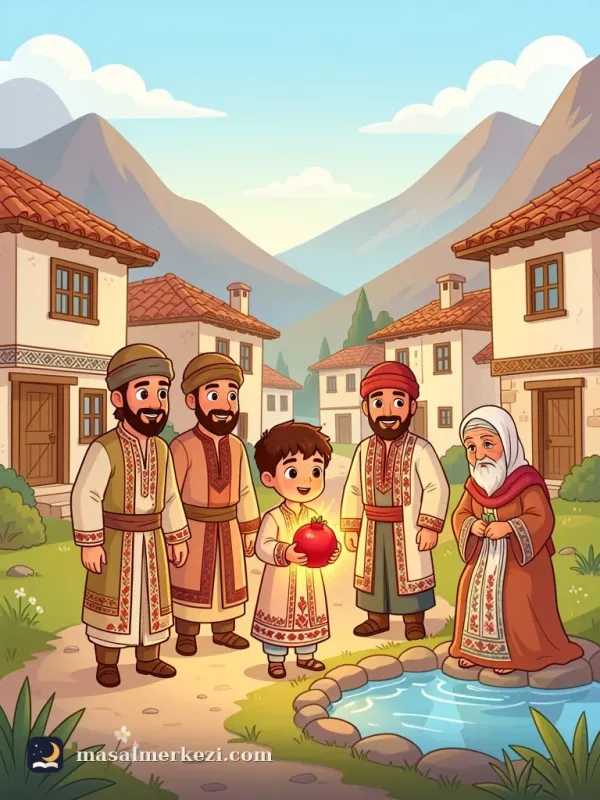
Long ago there was a sultan, and this sultan had forty sons. All day long they roamed the forests, snaring birds and chasing game. When the youngest turned fourteen, their father wanted to marry them. He called them all and told them his wish. The forty brothers said, "We will marry, but only if we find forty sisters of the same mother and the same father."
The sultan searched the whole land. He found families with thirty-nine sisters, but a family with forty sisters he could not find anywhere. "Let the fortieth of you marry another girl," said the sultan. But the forty brothers would not agree, and asked permission to search in other lands. What could the sultan do? He gave his permission. But before they left he called them to him and said:
"I will tell you three things; do not forget them. If on your journey you come to a large spring, do not spend the night beside it. Beyond the spring there is a caravanserai; do not stay there either. Beyond the caravanserai there is an endless desert; do not rest there for even a moment." The sons promised to keep their father's words, and with baggage light in weight but heavy in value, they mounted their horses and set off.
They rode and rode, and when evening came the large spring appeared before them. The elder brothers said, "We won't go another step. We're tired, and night has fallen. What should forty brave men fear?" They dismounted, ate their supper and fell asleep. Only the youngest brother, who was fourteen, stayed awake.
Towards midnight he heard a strange noise. He seized his weapons, turned towards the sound and saw before him a seven-headed dragon. They rushed at each other. Three times the dragon attacked the prince, but it could do him no harm. "Now it's my turn," cried the prince, and he struck the dragon such a blow that six of its seven heads fell to the ground. "Strike again," groaned the dragon. "I won't," said the prince, "I too came into the world only once." The dragon collapsed where it stood, but its one remaining head rolled and rolled until it stopped at the mouth of a well. "Whoever brings my soul out of this well shall have my treasure too," it said, and leapt into the well.
The prince took a rope, tied one end to a rock and, holding the other end, climbed down into the well. At the bottom he found an iron door. He opened it, went through, and saw before him a palace beside which his father's palace would have looked like a hut. In the palace there were forty rooms, and in each room a girl sat at her embroidery frame with great treasures behind her. "Are you a man or a jinni?" cried the frightened girls. "I am a man, a child of man," said the prince. "I defeated a seven-headed dragon and followed its rolling head down here."
How the forty girls rejoiced when they heard these words! They embraced the prince and begged him not to leave them there. They were forty sisters of one mother and one father. The dragon had carried them off from their parents, and they had no one left in the world to turn to. "We are forty brothers," said the prince, "and we are looking for forty girls." He said he would first go up to his brothers and then come back for them. He climbed out of the well, lay down beside the spring and fell asleep.
Early in the morning the forty brothers got up and laughed at their father for trying to frighten them about the well. Again they set off, and rode and rode, and when evening came a caravanserai appeared before them. "We won't go another step," said the elder ones. The youngest reminded them of their father's words, but they laughed at him. They ate, drank and slept. Again only the youngest stayed awake.
At midnight he heard a noise again. Before him appeared a seven-headed dragon even bigger than the first. The dragon attacked but could not defeat him; the prince struck once and six of the dragon's heads fell off. The dragon asked him to strike again, but the prince would not. The last head rolled into a well; the prince went down after it and found a palace even bigger than the first and full of even more treasure. He put a mark on the well, returned to his brothers, and was so worn out by the great fight that in the morning his brothers could hardly wake him.
Again they mounted and crossed hill and dale, and as the sun was setting an endless desert stretched before them. They ate and drank, and just as they were about to sleep, such a roaring and bellowing broke out that the mountains shook from their places. The princes trembled with fear, especially when they saw a gigantic seven-headed dragon coming towards them. The dragon was spitting fire in its rage and roaring: "Who defeated my two brothers? Bring him to me! I'll have a word with him too!"
The youngest brother saw that his brothers were half dead with fear. He gave them the keys to the two wells; in one was the treasure, in the other the forty girls. "Take everything home," he said. "First I will deal with this dragon, then I will follow you." The thirty-nine brothers wasted no time; they mounted their horses and galloped off. They took the treasure out of one well and the forty girls out of the other and went home to their father.
Now let us turn to the youngest brother. He fought the dragon, and the dragon fought him, but neither could defeat the other. When the dragon saw that it could not beat this brave young man, it said, "If you go to the land of Chin and Machin and bring me the sultan's daughter, I will leave you in peace." The prince could not hold out much longer, so he agreed. The dragon's name was Champalak. Champalak gave the prince a bridle: "Every day a fine horse comes here to graze. Catch it, put this bridle on its head and tell it to take you to Chin and Machin."
Soon a golden-maned horse came flying through the air. The moment the prince put the bridle on its head, the horse said, "What is your command, little sultan?" and in the blink of an eye the land of Chin and Machin lay before him. The prince went into the city and became the guest of an old woman in her hut. As he sipped his coffee he asked what people were talking about in the city. "A seven-headed dragon has set its eye on our sultan's daughter," said the woman. "For years there has been war because of it, and the dragon presses us so hard that not even a bird can fly into our land." "Where is the sultan's daughter?" asked the prince. "In a little pavilion in the sultan's garden. The poor girl can't set a foot outside."
The next day the prince went to the sultan's garden and begged the gardener to take him on as an apprentice. The sultan's daughter saw the new gardener's boy, called him to her window and asked how he had managed to come to that land. The prince told her that his father was a sultan, that on his way he had fought the dragon Champalak, and that he had promised to bring her to it. "But don't be afraid," he said, "my courage is greater than that dragon's greed. If you dare to come with me, I'll find a way to deal with it." The girl loved the prince dearly, and because she longed to be free of her captivity, she trusted him. One night they slipped out of the pavilion and went to the desert where the dragon lived. On the way they agreed that the girl should find out the dragon's talisman.
Champalak was wild with joy when he saw the girl. But whatever he did, the girl did nothing but weep. Days passed, weeks passed, and her tears never stopped. One day the girl said to the dragon, "If you want to see me happy, at least tell me what your talisman is." "Ah, my soul," said the dragon, "my talisman is in a place no one can reach. It is in a great palace in the neighbouring land. Some have gone there, but none has ever come back."
That was enough for the prince. He took the bridle, went to the seashore and called his golden-maned horse. "What is your command, little sultan?" "Take me to the neighbouring land, to the palace of the dragon Champalak's talisman." In the blink of an eye the palace stood before him. The horse said: "When we reach the palace, you will tie my bridle to the two iron gates. When I neigh once and strike my iron hooves together, a door will open. In that door you will see the open jaws of a lion. If you cannot defeat it with one blow, run, or you will lose your life."
They went up to the palace, the prince tied the horse to the two iron gates by its bridle, and when it neighed the door flew open. The prince struck the lion in the doorway with all his strength and laid it low. Behind the lion stood a little golden cage, and in the cage were three doves so beautiful that there were none like them in the world. These three doves were the dragon's life. The prince took one and began to stroke it, but suddenly, whirr, it flew out of his hand and away towards the dragon. The horse flew swiftly after it, and if it had not caught it, the prince would have been in trouble. The prince put all three doves back in the cage, mounted his horse, and in the blink of an eye he was in front of Champalak's palace.
At the gate of the palace the prince let one of the doves fly up into the sky; when it disappeared among the clouds, the dragon lost its strength. When the prince entered the dragon's room, the monster was lying on the floor with no strength left at all. When it saw the last doves in the prince's hand it begged, "Let me stroke them once before I die." The prince's heart softened, and he was just about to hold out the cage when the sultan's daughter ran up, snatched the cage and let the remaining doves fly out of the window into the sky. When the doves flew away, the dragon turned as stiff as a rock and never moved again. "It's good you didn't give it the cage," said the horse. "If it had taken the doves in its claws, it would have come back to life." Then the horse vanished, bridle and all.
They gathered the dragon's treasures and returned to Chin and Machin. The sultan had been so grieved by the loss of his daughter that he had fallen ill; he thought she had fallen into the dragon's hands. And now there was his daughter before him, holding a prince by the hand! Such a wedding was held that it seemed it would never end. After the wedding they set out with a great escort for the prince's father's land. The girl's brother, the young prince of Chin and Machin, came with them too.
There they had long believed the prince was dead. They would not believe it was him until he had told the story of the three seven-headed dragons and the forty girls. The thirty-nine brothers married thirty-nine of the sisters. The fortieth girl was waiting patiently. As soon as the prince of Chin and Machin saw her he liked her, and she liked him, and they married too. So the weddings of all forty were held together. The youngest prince and his wife spent half their lives in his father's land and half in Chin and Machin, and their days flowed by in happiness. Three apples fell from the sky: one for the one who told the tale, one for the one who listened, and one for the youngest prince, who never forgot his father's words.
The tale ends here. Sleep well.
The Forty Princes and the Seven-Headed Dragon is a children's tale from Anatolian folk tale, suitable for ages 7-12 and about 10 minutes long. Read it free on Masal Merkezi, play a lullaby or nature sound in the background, tap any word to see its Turkish meaning and save it to your favorites. For similar tales browse the Turkish Folk Tales category.
Sign up and your favorites and reading list follow you on every device.