The Little Mermaid
The youngest princess at the bottom of the sea is curious about the world of humans and trades her voice for a pair of legs.
Tap a word to see it in Turkish · Long press to translate the whole sentence.
Far out at sea the water is as blue as the petals of the loveliest cornflower and as clear as the purest glass. But it is very deep, deeper than any anchor can reach. Many church towers would have to be stacked one on top of another to reach from the bottom to the surface. That is where the sea people live.
You must not think that there is nothing at the bottom but bare white sand. No, the most wonderful trees and plants grow there; their stalks and leaves are so supple that the slightest movement of the water makes them stir as if they were alive. All the fishes, great and small, glide among the branches, just as birds fly through the air up here. In the deepest place of all stands the palace of the sea king. Its walls are made of coral, its tall pointed windows of the clearest amber, and its roof of mussel shells that open and close as the water flows over them. In every shell lie gleaming pearls, any one of which would be the pride of a queen's crown.
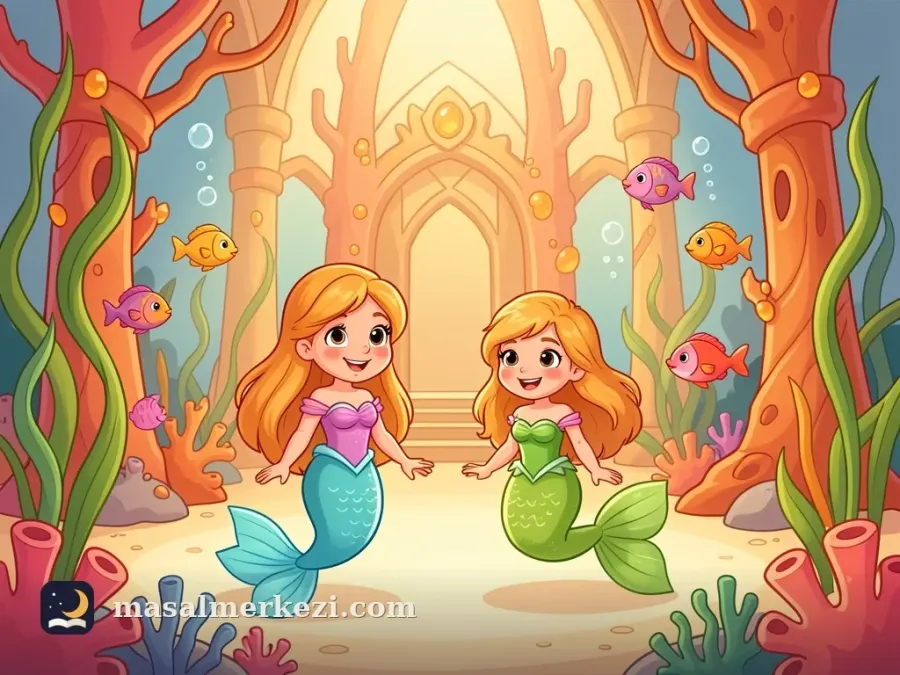
The sea king had been a widower for many years, and his old mother kept house for him. She was a wise woman, but very proud of her noble birth, so she wore twelve oysters on her tail, while other nobles were allowed to wear only six. But she deserved great praise, especially because she was so fond of the little sea princesses, her granddaughters. They were six lovely children, but the youngest was the most beautiful of all. Her skin was as clear and delicate as a rose petal, and her eyes were as blue as the deepest sea. But like all the others she had no feet; her body ended in a fish's tail.
All day long they played in the great halls of the palace. When the amber windows were opened, the fish swam in, ate from the princesses' hands and let themselves be stroked. Outside the palace was a great garden with fiery red and dark blue trees. Each princess had her own little plot in the garden, where she could dig and plant as she pleased. One made hers in the shape of a whale, another in the shape of a little mermaid. But the youngest made hers round like the sun and planted only flowers that shone red like the sun. She was a strange child, quiet and thoughtful. While her sisters decorated their gardens with the wonderful things they found in sunken ships, she loved only one thing besides her beautiful red flowers: a lovely marble statue of a boy, carved from clear white stone, which had sunk to the bottom from a wreck. Beside the statue she planted a rose-red weeping willow.
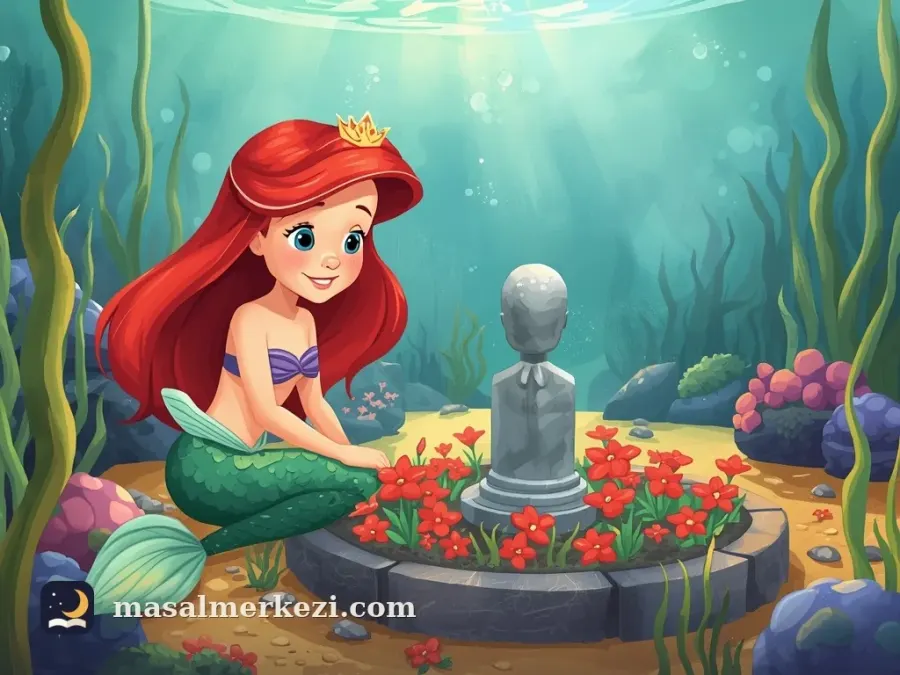
Nothing pleased her more than hearing about the world of people up above. Her old grandmother had to tell her all she knew about ships and towns, people and animals. She was amazed to hear that up on land the flowers had a scent, that the forests were green, and that the fishes that flew among the branches, the birds, sang so loudly and beautifully.
"When you are fifteen," said her grandmother, "you'll be allowed to rise to the surface of the sea. You can sit on the rocks in the moonlight and watch the great ships sail by. You'll see forests and towns too." One by one, each year, her sisters turned fifteen, rose to the surface, and came back to tell of the wonderful things they had seen. But none of them longed for it as much as the youngest, who had the longest to wait and who was the quietest and most thoughtful. Many a night she stood at the open window and looked up through the dark blue water, where the fish waved their fins and tails. She could see the moon and the stars, shining palely, but through the water they looked much bigger than they look to us.
At last the youngest princess turned fifteen too. "Now you're grown up," said her grandmother. "Come, let me dress you like your sisters." She put a wreath of white lilies in her hair, each petal half a pearl. Then she had eight big oysters fastened to her tail to show her high rank. "That hurts so much," said the little mermaid. "You must suffer a little to be beautiful," said her grandmother. Oh, how gladly she would have shaken off all this finery and taken off the heavy wreath! The red flowers in her garden would have suited her far better. But she could not. "Goodbye," she said, and rose as lightly as a bubble to the surface of the water.
When she lifted her head out of the water, the sun had just set. All the clouds were shining like roses and gold, and in the middle of the pale red sky the evening star was sparkling. The air was mild and fresh, and the sea was perfectly calm. A great ship with three masts lay there. Only one sail was up, for there was not a breath of wind. Music and singing came from the deck. As darkness fell, hundreds of coloured lanterns were lit. The little mermaid swam right up to the cabin window, and every time a wave lifted her, she looked in through the clear glass. Inside were many finely dressed people, but the handsomest of all was a young prince with big dark eyes. He could not have been more than sixteen. It was his birthday, and all this celebration was for him.
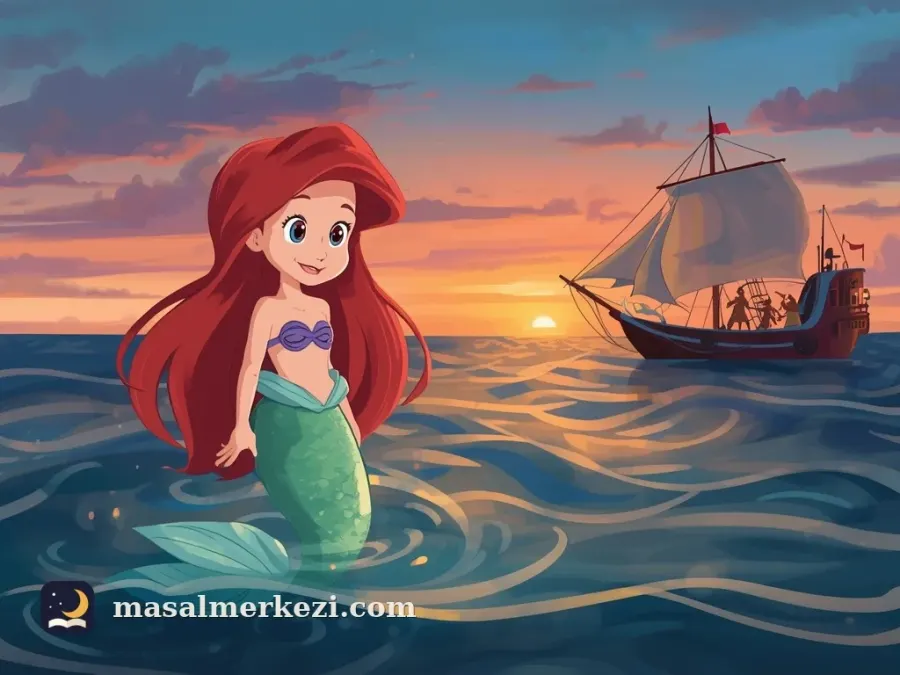
The night wore on, but the little mermaid could not take her eyes off the ship and the handsome prince. Suddenly the ship began to move quickly, sail after sail was spread, the waves rose higher, and lightning flashed in the distance. A terrible storm was coming. The ship plunged like a swan between the enormous waves. At last its timbers groaned, the mainmast snapped like a reed, and the ship heeled over and the water rushed in. Then the little mermaid understood that the people were in danger. For a moment it was pitch dark, and then, in a flash of lightning, she saw the prince fall from the sinking ship into the deep sea.
At first she was overjoyed, for now he would come down to her. But then she remembered that people cannot live in water. He would come to her father's palace dead. No, he must not die! She swam among the beams and planks floating on the sea, never thinking that they might crush her. She dived deep down and came up again among the waves, and at last she reached the young prince. He had grown weak, and his eyes had closed; he would have died if the little mermaid had not come. She held his head above the water and let the waves carry them wherever they would.
By morning the storm was over. The sun rose red and seemed to bring life into the prince's cheeks, but his eyes remained closed. The mermaid kissed his high, handsome forehead and stroked back his wet hair. Ahead of them she saw land; high blue mountains, with white snow shining on their peaks as if swans were resting there. Near the shore stood a white building, a church or a convent. The mermaid swam there with the handsome prince, laid him on the sand, and lifted his head up towards the warm sun.

Bells rang from the big white building, and many young girls came out into the garden. The mermaid swam a little way off, covered her hair and her breast with sea foam so that no one could see her face, and waited to see who would come to the poor prince. Before long a young girl came. She seemed very frightened, but only for a moment; then she called other people. The mermaid saw the prince come back to life and smile at everyone around him. But he did not smile at her; he did not know that she had saved him. The mermaid felt very sad, and when he was carried into the big building, she dived sorrowfully down into the sea and went back to her father's palace.
She had always been quiet, but now she became even quieter and more thoughtful. Many mornings and evenings she swam back to the place where she had left the prince. She saw the fruit in the garden ripen and the snow melt, but she never saw the prince. At last she could bear it no longer and told one of her sisters. Her sisters knew where the prince lived and took her there. Now that she knew where he lived, she went there many evenings and nights. She swam right up under his balcony and watched the prince, who thought he was alone, sailing in his little boat in the moonlight.
She grew more and more fond of people and longed more and more to live among them. She asked her grandmother: "If people don't drown, do they live forever?" "No," said her grandmother. "They die too, and their lives are even shorter than ours. We can live for three hundred years, but at the end we turn into foam on the sea. But people have an immortal soul, which lives on after their bodies have turned to dust. It rises up through the clear air to the shining stars." "How can I get an immortal soul too?" asked the little mermaid. "Only if a human loves you more than his father and mother, if all his thoughts and love are fixed on you, and the priest puts his right hand in yours with a promise to be faithful to you forever, then his soul will flow into your body. But that can never happen. The fish's tail that is thought so beautiful here in the sea is thought ugly on land."
The little mermaid sighed and looked sadly at her fish's tail. There was a great ball at the palace, but she could not stop thinking of the prince and the immortal soul. She slipped out of her father's palace and went to the sea witch. She had always been afraid of her, but perhaps the witch could help. The witch's house was in a terrible place; she had to pass through whirlpools and then through a forest of polyps, half animal and half plant. The little mermaid was so frightened that she almost turned back, but she thought of the prince and her soul and took courage.
"I know what you want," said the sea witch. "It's very foolish of you, but you shall have your way, my pretty princess, for it will bring you misfortune. You want to get rid of your fish's tail and have two legs like a human, so that the young prince will fall in love with you and you can win an immortal soul." The witch gave a horrible laugh. "I'll make you a potion. Swim to land before sunrise, sit on the shore and drink it. Then your tail will divide and shrink into what humans call pretty legs. But it will hurt, as if a sharp sword were passing through you. Everyone who sees you will say you're the loveliest human child they have ever seen. You'll keep your graceful way of moving; no dancer will glide as lightly as you. But every step you take will feel as though you were treading on a sharp knife. If you're willing to bear all this, I'll help you."
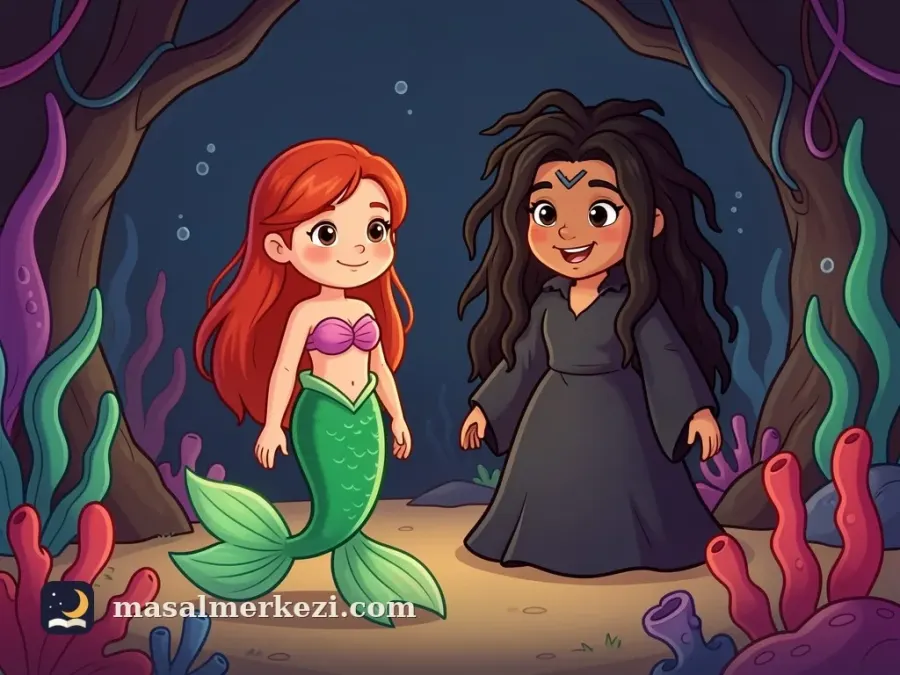
"Yes," said the little mermaid in a trembling voice, thinking of the prince and the immortal soul. "But remember," said the witch, "once you have taken human shape, you can never become a mermaid again. You can never go back to your sisters and your father's palace. And if you don't win the prince's love, if he leaves you and marries someone else, then on the morning after their wedding your heart will break and you'll become foam on the sea." "I want it," said the little mermaid, as pale as death. "But you must pay me," said the witch, "and what I ask is no small thing. Your voice is the loveliest of anyone's at the bottom of the sea. You think you can enchant the prince with it, but you must give it to me."
The little mermaid gave up her voice; now she could neither sing nor speak. She took the potion and passed by the palace. The torches in the great hall had gone out, and everyone was asleep. She did not dare go in, for now she was dumb and was going to leave her sisters forever. Her heart felt as if it would break with sorrow. She crept into the garden, took a flower from each of her sisters' flower beds, blew a thousand kisses towards the palace, and rose up through the dark blue sea.
The sun had not yet risen when she saw the prince's palace and climbed the marble steps. The moon was shining brightly. The little mermaid drank the burning, bitter potion; it felt as if a two-edged sword were passing through her delicate body, and she fainted and lay as if dead. When the sun began to shine over the sea, she woke and felt a sharp pain. But right in front of her stood the handsome young prince. He fixed his coal-black eyes on her. She cast down her eyes and saw that her fish's tail was gone, and in its place she had the prettiest white legs any little girl could have. The prince asked who she was and how she had come there, and she looked at him sweetly and sadly with her dark blue eyes, for she could not speak.
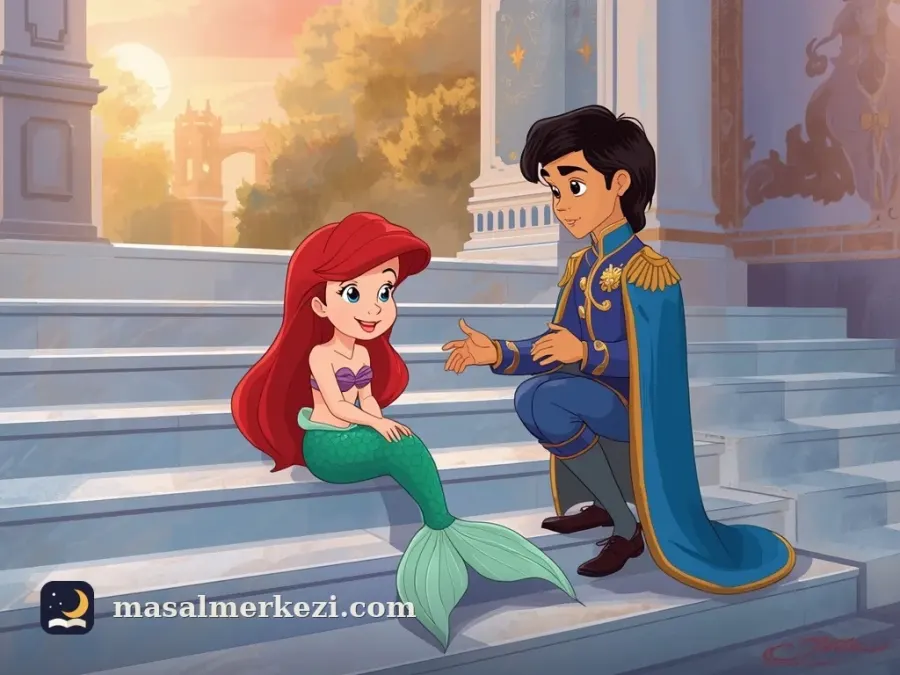
He took her by the hand and led her into the palace. As the witch had said, every step felt like treading on sharp needles and knives; but she bore it gladly. She walked beside the prince as lightly as a bubble, and everyone marvelled at her graceful walk. They dressed her in costly clothes of silk and muslin; she was the loveliest in the palace. But she was dumb; she could neither sing nor speak. Beautiful slave girls in silk and gold sang for the prince and his family. One sang more beautifully than all the rest, and the prince clapped his hands and smiled at her. That made the mermaid sad, for she knew that she could sing far more beautifully.
Then the slave girls danced gracefully to the loveliest music. The little mermaid raised her beautiful white arms, rose on the tips of her toes and glided across the floor, dancing as no one had ever danced before. With every movement her beauty became more apparent, and her eyes spoke more deeply to the heart than the slave girls' singing. Everyone was enchanted, especially the prince. He called her his "little foundling". She went on dancing, though every time her feet touched the floor it was as if she were treading on sharp knives. The prince said she must always stay with him.
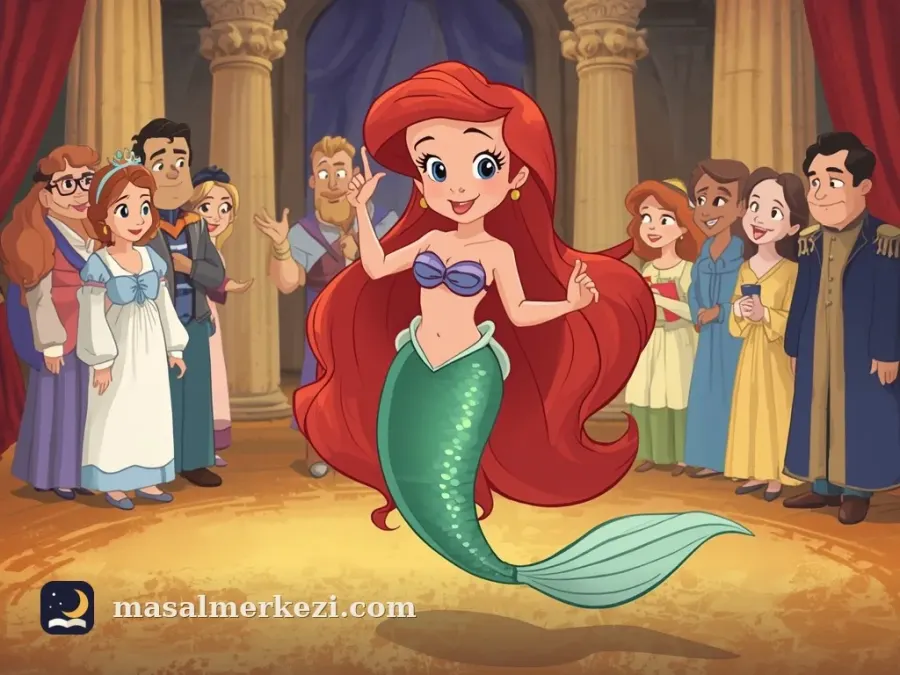
Day by day the prince grew fonder of her; but he loved her as one loves a dear, good child. It never occurred to him to make her his queen. And yet she had to become his wife, or she would never win an immortal soul and would turn into sea foam on the morning of his wedding. "Don't you love me best of all?" the little mermaid's eyes seemed to ask when he took her in his arms and kissed her lovely forehead. "Yes, you're the dearest of all to me," said the prince, "for you have the best heart of all. You remind me of a young girl I once saw but shall never find again. I was on a ship that was wrecked; the waves threw me ashore near a temple where many young girls served. The youngest of them found me on the shore and saved my life. I saw her only twice. She is the only one in the world I could ever love. But you're like her, and you almost drive her image out of my heart."
"Ah, he doesn't know that it was I who saved his life," thought the little mermaid. "I carried him over the sea to the forest where the temple stands. I sat behind the foam and waited to see whether anyone would come. I saw the pretty girl he loves more than me." And the mermaid sighed deeply; she could not cry.
Soon it was said that the prince was to marry the beautiful daughter of the neighbouring king. A splendid ship was made ready. The prince said he was going to see the princess because his father and mother wished it. "But I don't have to love her," he told the mermaid. "She isn't like the beautiful girl in the temple; you are. If I ever have to choose a bride, I'd rather choose my dumb foundling with the speaking eyes." And he kissed her red lips, played with her long hair and laid his head against her heart, and she dreamed of human happiness and an immortal soul.
But when the ship reached the neighbouring king's city and the princess came, the prince cried out: "It's you! You're the one who saved me when I lay as if dead on the shore!" And he took his blushing bride in his arms. The neighbouring king's daughter had been brought up in the temple and had served there. "Oh, I'm so happy," said the prince to the little mermaid. "The greatest wish I never dared to hope for has come true. You'll rejoice at my happiness, for you love me more than anyone." The little mermaid kissed his hand and felt her heart breaking. His wedding morning would bring her death and turn her into sea foam.
The wedding was held that same evening on board the ship. Church bells rang and banners waved. At night coloured lanterns were lit on deck, and the sailors danced. The little mermaid danced too; though the sharp knives cut her feet, she did not feel it, for the pain in her heart was far greater. She knew it was the last time she would see the prince, for whom she had given up her voice, her home and her family and suffered endless pain every day, without his knowing anything about it. After midnight everyone went to bed, and the ship grew quiet. The mermaid leaned her white arms on the rail and looked towards the east, towards the red of dawn. She knew that the first ray of sunlight would kill her.

Just then she saw her sisters rising out of the sea. They were as pale as she was; their long, beautiful hair no longer waved in the wind, for it had been cut off. "We gave our hair to the sea witch so that she would help you not to die tonight. She gave us a knife; here it is. Before the sun rises, you must plunge it into the prince's heart. When his warm blood falls on your feet, they will grow together into a fish's tail again, you'll be a mermaid once more and live with us for three hundred years. Hurry! Either he or you must die before sunrise." And with a deep sigh they sank beneath the waves.
The little mermaid drew back the purple curtain of the tent and saw the beautiful bride asleep with her head on the prince's breast. She bent down and kissed his handsome forehead and looked at the reddening sky. She looked at the knife, and then again at the prince, who was murmuring his bride's name in his sleep. The knife trembled in the mermaid's hand. Then she flung it far out into the waves. Where it fell, the waves shone red like drops of blood. Once more she looked at the prince with half-dimmed eyes, then threw herself from the ship into the sea and felt her body dissolving into foam.
The sun rose out of the sea. Its rays fell gently and warmly on the cold sea foam. But the little mermaid did not feel death. She saw the bright sun, and all around her floated hundreds of transparent, lovely beings. Their voices were like music, but so delicate that no human ear could hear them. They had no wings, but they floated through the air by their own lightness. The little mermaid saw that she had a body like theirs and was rising higher and higher out of the foam. "Where am I going?" she asked, and her voice sounded like theirs.
"To the daughters of the air," they answered. "A mermaid has no immortal soul and can never have one unless she wins a human's love. The daughters of the air have no immortal soul either, but they can earn one by their good deeds. We fly to the hot countries and cool the sultry air that brings sickness. We spread the scent of flowers through the air and send healing and refreshment. When we have tried to do all the good we can for three hundred years, we receive an immortal soul. You, poor little mermaid, have striven with all your heart for the same thing we strive for. You have suffered and endured, and raised yourself to the world of the spirits of the air. Now you too can earn an immortal soul through good deeds in three hundred years."
The little mermaid lifted her transparent arms towards God's sun and for the first time felt tears in her eyes. On the ship there was life and movement again. She saw the prince and his beautiful bride searching for her; they gazed sadly into the bubbling foam, as if they knew she had thrown herself into the sea. Invisible, she kissed the bride's forehead, smiled at the prince, and rose with the other children of the air up to a rosy cloud floating in the sky.

And the daughters of the air whispered: "If we find a good child in a house, a child who makes its parents happy and deserves their love, God shortens our time of trial. The child does not know when we float through the room, but when we smile with joy at a good child, a year is taken off our three hundred." So, dear child, while you are good, perhaps the soft breeze that comes in through the window is the little mermaid smiling at you.
The tale ends here. Sleep well.
The Little Mermaid is a children's tale from Hans Christian Andersen, suitable for ages 6-11 and about 18 minutes long. Read it free on Masal Merkezi, play a lullaby or nature sound in the background, tap any word to see its Turkish meaning and save it to your favorites. For similar tales browse the Andersen Fairy Tales category.
Sign up and your favorites and reading list follow you on every device.