The Nightingale
The emperor of China chooses a jeweled toy nightingale over the real one, until he falls ill.
Tap a word to see it in Turkish · Long press to translate the whole sentence.
In China, as you surely know, the emperor is Chinese, and everyone around him is Chinese too. This story happened many years ago; but that is exactly why it is worth hearing, before it is forgotten.
The emperor's palace was the most beautiful palace in the world. It was made entirely of fine porcelain, very costly, but so fragile that you had to be very careful when you touched it. In the garden grew the most wonderful flowers; to the most beautiful of them little silver bells were tied, which tinkled so that no one could walk past without noticing them. Yes, everything in the emperor's garden had been very cleverly thought out. The garden stretched so far that even the gardener did not know where it ended. Beyond the garden lay a beautiful forest with tall trees and deep lakes. The forest went right down to the sea, which was deep and blue, and great ships could sail right under the branches. In those branches lived a nightingale. It sang so beautifully that even the poor fisherman, who had so much else to do when he went out at night to draw in his nets, would stop and listen. "Goodness, how beautiful it is!" he would say. But then he had to go back to his work and forgot the bird. The next night, when it sang again, the fisherman said again, "Goodness, how beautiful it is!"
Travellers came from every country in the world to the emperor's city. They admired the city, the palace and the garden. But when they heard the nightingale, they all said, "That is the best of all!" When the travellers went home, they talked about it, and learned men wrote many books about the city, the palace and the garden; but they did not forget the nightingale; it was praised above everything. And those who could write poetry wrote the loveliest poems about the nightingale that lived in the forest by the deep lake.
The books went all around the world, and one day one of them reached the emperor. He sat on his golden throne and read and read, and kept nodding his head, for he was delighted by the fine descriptions of his city, his palace and his garden. "But the nightingale is the best of all!" it said in the book. "What's this?" said the emperor. "The nightingale? I don't know it at all! Is there such a bird in my empire, in my very own garden? I've never heard of it! Fancy having to learn such a thing from a book!"
The emperor summoned his chamberlain. The chamberlain was so grand that when anyone of lower rank dared to speak to him or ask him something, he only said "P!", which means nothing at all. "There is said to be a most remarkable bird here called a nightingale," said the emperor. "They say it is the finest thing in my great empire. Why has no one ever told me about it?" "I have never heard of it," said the chamberlain. "It has never been presented at court." "I want it to come here this evening and sing for me," said the emperor. "The whole world knows what I have, and I don't!"
The chamberlain searched the whole palace; he ran up and down the stairs and through the halls and corridors, but no one he met had ever heard of the nightingale. At last they came upon a poor little girl who worked in the kitchen. She said: "Oh, I know the nightingale well! How beautifully it sings! Every evening I'm allowed to take the leftovers from the table home to my poor sick mother, who lives down by the shore. On the way back, when I'm tired and rest in the forest, I hear the nightingale sing. It brings tears to my eyes; it's as if my mother were kissing me." "Little kitchen maid," said the chamberlain, "if you take us to the nightingale, I'll get you a permanent position in the kitchen and permission to watch the emperor eat his dinner."
So they set off for the forest where the nightingale sang, and half the court went with them. On the way a cow began to moo. "Ah!" said the courtiers. "There it is! What a powerful voice for such a small creature! We must have heard it before." "No, that's a cow mooing," said the little kitchen maid. "We still have a long way to go." Then the frogs began to croak in the marsh. "Lovely!" said the court chaplain. "Like little church bells." "No, those are frogs," said the kitchen maid. "But I think we'll hear it soon."
Then the nightingale began to sing. "That's it!" said the little girl. "Listen, listen! There it is, sitting up there." And she pointed to a little grey bird up in the branches. "Is it possible?" said the chamberlain. "I never imagined it like that. How plain it looks! It must have lost its colour at seeing so many fine people." "Little nightingale," called the kitchen maid loudly, "our gracious emperor would like you to sing for him." "With the greatest pleasure," said the nightingale, and it sang so beautifully that everyone was delighted.
"It sounds like glass bells," said the chamberlain. "And look at that little throat, how it works! It's strange that we've never heard it before. It will be a great success at court." "Shall I sing once more for the emperor?" asked the nightingale, who thought the emperor was there too. "My dear little nightingale," said the chamberlain, "I have the great pleasure of inviting you to a court festival this evening, where you will enchant His Imperial Majesty with your charming song." "My song sounds best out in the green forest," said the nightingale; but when it heard that the emperor wished it, it went gladly.
The palace was polished and decorated. The porcelain walls and floors gleamed in the light of thousands of golden lamps. The most beautiful flowers with their little bells were placed in the corridors. In the middle of the great hall, where the emperor sat, a golden perch had been set up for the nightingale. The whole court was there, and the little kitchen maid was allowed to stand behind the door, for she now had the title of real court cook. Everyone wore their finest clothes, and they all looked at the little grey bird to which the emperor nodded.
And the nightingale sang so beautifully that tears came into the emperor's eyes and ran down his cheeks. The nightingale sang more beautifully still; its song went straight to the heart. The emperor was so delighted that he wanted his golden slipper to be hung around the nightingale's neck. But the nightingale thanked him and said it had been rewarded enough: "I have seen tears in the emperor's eyes; that is the greatest treasure for me. An emperor's tears have a wonderful power. Heaven knows, I am rewarded enough."
The nightingale was now to stay at court; it would have its own cage, with permission to go out twice a day and once at night. Each time it would be accompanied by twelve servants, who held tightly to a silk ribbon tied around its leg. There was no pleasure at all in an outing like that. The whole city talked about the wonderful bird.
One day a large parcel arrived for the emperor, with "Nightingale" written on it. "Here's a new book about our famous bird," said the emperor. But it was not a book; it was a little work of art lying in a box: an artificial nightingale that looked like the real one, but was covered all over with diamonds, rubies and sapphires. When it was wound up, it sang one of the songs the real nightingale sang, and its tail went up and down, glittering with silver and gold. Around its neck hung a little ribbon, on which was written: "The Emperor of Japan's nightingale is poor compared with the Emperor of China's."
"How beautiful!" said everyone. The person who had brought the artificial bird was at once given the title of "Imperial Nightingale Bringer". "Now they must sing together; what a duet that will be!" But it did not go very well, for the real nightingale sang in its own way, while the artificial bird went tick-tock, always in the same rhythm. "It's not its fault," said the court music master. "It keeps perfect time and sings according to my method." Then the artificial bird sang alone. It was just as successful as the real one, and besides, it was much prettier to look at; it sparkled like bracelets and brooches.
It sang the same song thirty-three times without growing tired. Everyone wanted to hear it again. But the emperor wanted the real nightingale to sing a little too. But where was it? No one had noticed it fly out of the open window and back to its green forest. "What does this mean?" said the emperor. The courtiers scolded the nightingale and said it was a most ungrateful creature. "But we have the best bird after all," they said, and the artificial bird sang again. And the real nightingale was banished from the empire.
The artificial bird was placed on a silk cushion beside the emperor's bed, and all the gold and precious stones it had been given lay around it. Its title was "Imperial Bedside Singer". So a whole year passed. The emperor, the court and all the Chinese knew every little "tick" in the artificial bird's song by heart; and that was exactly why they liked it so much. But one evening, while the artificial bird was singing its best and the emperor lay in bed listening, something inside the bird went "Whirr!" Something snapped. "Whirrrrr!" All the wheels spun round, and the music stopped.
The emperor jumped out of bed at once and sent for his personal physician; but what could he do? Then they fetched the watchmaker, who, after much talking and examining, repaired the bird after a fashion. But he said it must be used very carefully, for its cogs were worn and it was impossible to put in new ones without spoiling the music. That was a great sorrow. Now the bird was allowed to sing only once a year, and even that was a strain.
Five years went by, and then a great sorrow fell over the land. The Chinese loved their emperor, and now he was ill and was not expected to live. A new emperor had already been chosen. People in the streets asked the chamberlain how their old emperor was. "P!" said the chamberlain, and shook his head.
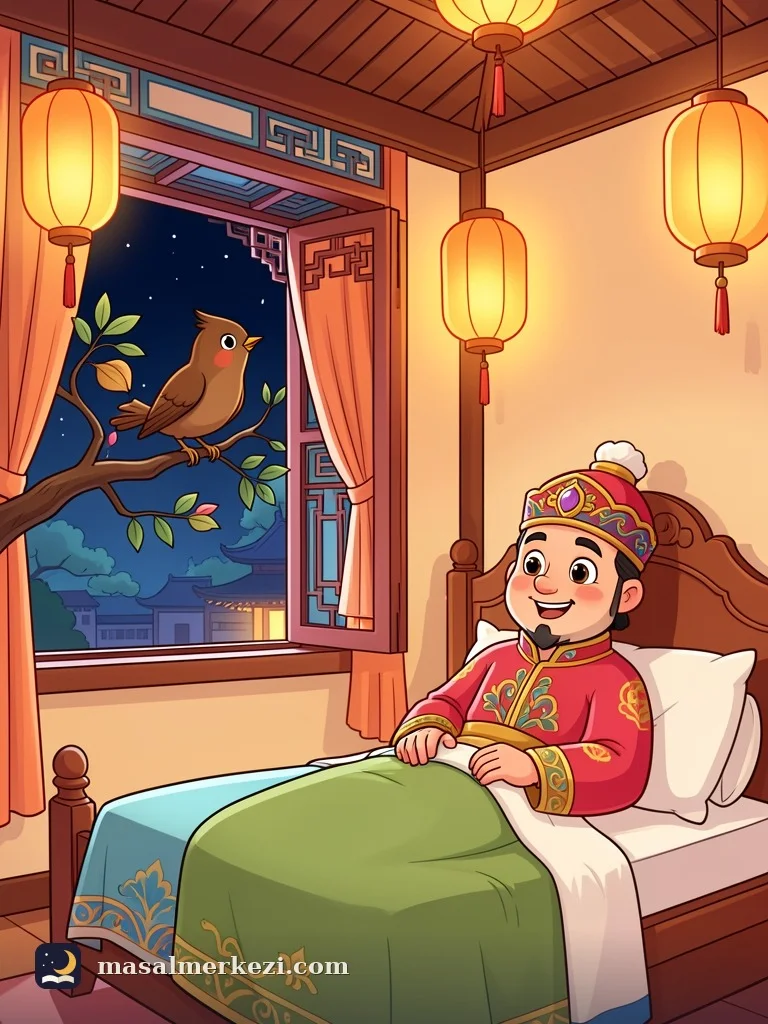
The emperor lay cold and pale in his great, splendid bed. The whole court believed he was dead, and everyone ran off to greet the new emperor. But the emperor was not dead; he lay stiff and pale in his splendid bed with its velvet curtains and golden tassels. High up a window stood open, and the moonlight shone on the emperor and the artificial bird.
The poor emperor could hardly breathe; it was as if something was sitting on his chest. He opened his eyes and saw that it was Death sitting on his chest; he had put on the emperor's golden crown and held the emperor's golden sword in one hand and his splendid banner in the other. From among the folds of the bed curtains strange faces peered out, some very ugly, others kind and gentle. They were the emperor's good and bad deeds, looking at him now that Death sat upon his heart. "Do you remember this?" they whispered one after another. "Do you remember that?" They told him so many things that sweat ran from his forehead.
"I never knew that!" said the emperor. "Music! Music! Beat the great Chinese drum," he cried, "so that I don't have to hear what they're saying!" But they went on, and Death nodded at everything that was said. "Music, music!" cried the emperor. "You precious little golden bird, sing, sing! I gave you gold and precious stones, I hung my golden slipper around your neck, sing, sing!" But the bird was silent. There was no one to wind it up, and it could not sing without being wound. Death went on staring at the emperor with his great hollow eyes, and everything was silent, terribly silent.
Then, close by the window, the loveliest song rang out. It was the little living nightingale, sitting on a branch outside. It had heard of the emperor's illness and had come to sing him comfort and hope. As it sang, the phantoms grew paler and paler, the blood flowed faster through the emperor's weak body, and even Death listened and said: "Go on, little nightingale, go on!" "Yes, if you'll give me that fine golden sword! If you'll give me that rich banner! If you'll give me the emperor's crown!" And Death gave up each of his treasures for a song. The nightingale went on singing; it sang of the quiet churchyard where the white roses grow, where the elder tree smells sweet, and where the fresh grass is watered by the tears of mourners. Death longed for his own garden and floated out of the window like a cold white mist.
"Thank you, thank you!" said the emperor. "You heavenly little bird, I know you well! I drove you out of my land and my empire. And yet you have sung the evil phantoms away from my bed and Death away from my heart. How can I reward you?" "You have rewarded me already," said the nightingale. "The first time I sang, I saw tears in your eyes; I shall never forget that. Those are the jewels that gladden a singer's heart. But now sleep and grow strong and well again. I will sing to you."
The nightingale sang, and the emperor fell into a sweet sleep; how peaceful and refreshing that sleep was! When he woke, the sun was shining in through the window; he was strong and well. None of his servants had come to him, for they thought he was dead; but the nightingale was still there, singing. "You must always stay with me," said the emperor. "You shall sing only when you want to. And I'll break the artificial bird into a thousand pieces." "Don't do that," said the nightingale. "It did all the good it could; keep it. I can't live in a palace or build my nest here. But let me come when I like. Then in the evenings I'll sit on the branch by your window and sing to you, so that you may be glad and thoughtful too. I'll sing of those who are happy and those who suffer; I'll sing of the good and the evil that are hidden from you all around you. The little songbird flies far away, to the poor fisherman and the farmer's roof, far from you and your court. I love your heart more than your crown; and yet the crown has something holy about it. I will come and sing to you. But you must promise me one thing." "Anything!" said the emperor. "Don't tell anyone that you have a little bird who tells you everything. It will be better that way." And the nightingale flew away.
The servants came in to look at their dead emperor. There they stood, and the emperor said: "Good morning!"
The tale ends here. Sleep well.
The Nightingale is a children's tale from Hans Christian Andersen, suitable for ages 5-10 and about 13 minutes long. Read it free on Masal Merkezi, play a lullaby or nature sound in the background, tap any word to see its Turkish meaning and save it to your favorites. For similar tales browse the Bedtime Stories category.
Sign up and your favorites and reading list follow you on every device.