The Padishah of the Forty Peris
A princess falls in love with the white dove that snatched her ring, bracelet and handkerchief, and with the help of a bald young man she finds Bahtiyar Bey, held captive by forty peris.
Tap a word to see it in Turkish · Long press to translate the whole sentence.
In the old, old days, in the age of fairy tales, there was a sultan's daughter as lovely as the full moon, as slender as a cypress, with eyes like embers, hair like the night and eyebrows like bows. In the sultan's palace there was a garden, and in the middle of the garden a fountain. The girl sat there all day long, sewing and embroidering.
One day she put her ring on her sewing table. No sooner had she put it down than a little dove came, snatched the ring and flew away. The dove was so lovely that the girl gave her heart to it at once. The next day she took off her bracelet, and again the dove came and flew off with it. Now the girl was so lovesick that she neither ate nor drank; she could hardly wait for the next day for the dove to come again. On the third day she brought her sewing table, put her lace handkerchief on it and sat right beside it. She waited and waited; suddenly the dove appeared before her again, snatched the handkerchief and flew away.
The girl hardly had the strength to stand; weeping bitterly, she went into the palace and threw herself on the floor. Her old nurse came running: "My sultana, why are you crying like this? What's the matter?" "I'm ill, my heart is ill!" said the girl, and wept even harder. At first the nurse was afraid to tell anyone, because the girl was the sultan's only daughter. But when she saw the girl growing paler and paler, she gathered her courage, went to the sultan and told him of his daughter's sorrow.
The sultan was frightened and went to see his daughter. After him came many wise men and many skilled doctors, but none of them could cure her illness. The next day the sultan's vizier said: "Neither wise men nor doctors can help the girl; the medicine that will cure her is hidden somewhere else." He advised the sultan to build a great bathhouse, to announce that its water would cure all the sick, but to make it a condition that everyone who bathed there must tell the story of their life.
The sultan had the bathhouse built and had it proclaimed that its water would give back the bald man his hair, the deaf his hearing, the blind his sight and the lame his legs. All the people flocked there to bathe for free, and before going home each of them told the story of their life and their trouble.
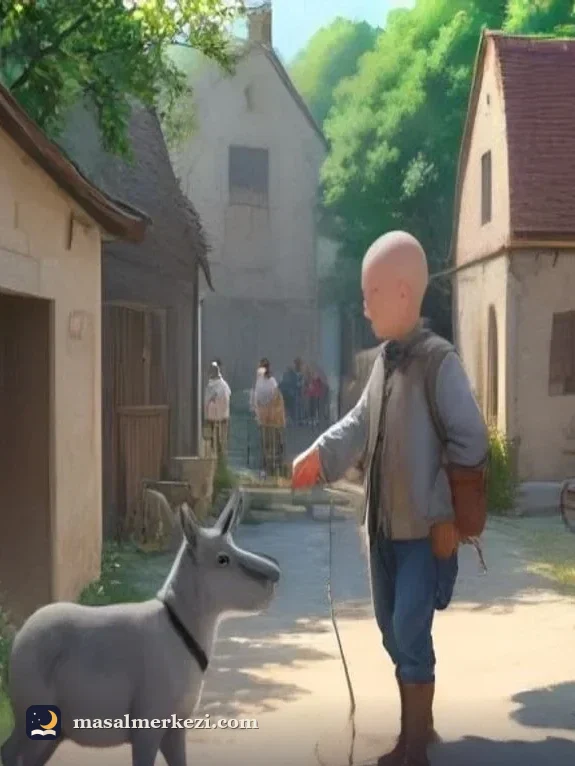
In that city lived the bald son of a bedridden mother. "Let's go too," said the son. "Perhaps we'll both be cured." "I can't stand on my feet; how can I go?" groaned the old woman. "We'll find a way," said the bald boy, and he took his mother on his back and set off for the bathhouse.
They went and went across the level plains beside a flowing river; at last the son grew tired and put his mother down. At that very moment a rooster landed beside them, carrying a big water jug on its back, and hurried off. The young man was very curious to know where and why this rooster was carrying water, and he followed it. The rooster came to a great castle. At the foot of the castle was a little hole through which water was gurgling. With great difficulty the young man squeezed through the hole, and as soon as he looked around he saw such a magnificent palace that his eyes and mouth hung open in amazement.
No human being had ever set foot on the path to that palace. The young man wandered all over the palace, through all the rooms, and at last grew tired. "If only I could find a living creature here," he said, and hid in a large wardrobe from which he could see whoever came. Before long three doves landed on the window sill; they trembled and shook themselves a little and turned into three beautiful girls. "Oh no, oh no, we're late!" they cried. "Our padishah will be here soon, and nothing is ready!" One grabbed a broom and swept everywhere, the second laid the table, and the third brought all kinds of dishes. Then all three trembled again, became three doves and flew out of the window.
Meanwhile the bald boy had grown very hungry. "No one can see me; what harm if I take a bite or two from the table?" he thought. He stretched his hand out from his hiding place, but just as he was about to touch the food, he got such a slap on the fingers that his hand swelled up. He stretched out his other hand and got an even bigger slap on that. The young man was very frightened, and as soon as he pulled his hand back, a white dove flew into the room. The dove trembled and at once turned into a handsome young man.
The young man went to a cupboard, opened it and took out a ring, a bracelet and a lace handkerchief. "Ah, lucky ring, you were worn on a lovely finger," he said. "Ah, lucky bracelet, you adorned a lovely arm." Then he sobbed and wiped his tears one by one with the lace handkerchief. Then he put everything back in the cupboard, tasted a bite or two of the food and lay down to sleep.
The bald boy could hardly wait for morning. At dawn the handsome young man got up, trembled, became a white dove and flew away. The bald boy came out of his hiding place, went down and squeezed back through the hole at the foot of the tower. Outside he found his poor mother crying all alone. He calmed her by telling her that their troubles were nearly over, took her on his back again and went to the bathhouse.
They bathed; at once the old woman could stand on her feet, and the bald boy's hair grew back. Then they began to tell their stories. When the sultan's daughter heard what the young man had seen and heard at midnight, it was as if a spring of fresh health flowed into her. She got up from her bed and promised the young man a great treasure if he would take her to that tower.
The young man took the sultan's daughter and showed her the walls of the palace, helped her through the little hole, brought her to the doves' room and showed her the wardrobe where he had hidden. Then he went home with great treasure and in perfect health, and spent the rest of his life happily with his old mother.
When evening came the three doves flew into the room. They cleaned and swept, brought the dishes to the table and flew away again. Soon after, the white dove arrived. What did the girl feel when she saw her beloved dove again! But when the dove turned into a young man and stood before her shining like the full moon, the girl hardly knew where she was and could not take her eyes from his radiant face. Again the young man opened the cupboard and took out the ring, the bracelet and the lace handkerchief: "Ah ring, how happy you are on a lovely finger! Ah bracelet, how happy you are on a lovely arm!" When he wiped his tears with the handkerchief, the girl's heart nearly broke, and she tapped on the wardrobe door with her fingers.
When the young man opened the door, he saw his heart's beloved before him. His joy was so great that it was almost pain. He asked the girl how she had come to the palace of the peris. The girl told him of her journey and how she had fallen ill with love. The young man told her that he too was a child of man, but when he was only three days old the peris had stolen him, brought him to this palace and made him their padishah. He was with them all day, and of every twenty-four hours only two were his own. "You may stay here," he said, "but towards evening you must hide; if the forty peris see you with me, they will harm you. Tomorrow I will show you my mother's house. There you can live in peace, and for two hours of every twenty-four I will be with you."
The next day the padishah of the peris took the girl and showed her his mother's house. "When you go there, ask them to take you in for the sake of Bahtiyar Bey. When my mother hears my name, she will not turn you away." The girl went to the house and knocked at the door. An old woman opened it; when she saw the girl and heard her son's name, she burst into tears and took her in. The girl stayed there a long time. Every day Bahtiyar Bey came as a bird for two hours and talked with her. One day they were quietly married, and before long they had a son. But the old woman knew neither that her son came to the house nor about her grandson.
One day the bird came and landed on the window sill: "O my sultana, what is our little sapling doing?" The girl said, "Nothing has happened to our little sapling, but he is waiting for Bahtiyar to come." "Ah, if my mother knew, she would open her finest room," sighed the young man. Then he flew into the room, became a man and embraced his wife and little son. When the two hours were up, he trembled a little, became a little dove and flew out of the window.
But the mother had heard her son's voice and could hardly contain her joy. At once she ran to her daughter-in-law, hugged and caressed her, took her to her finest room and made everything ready for her son's arrival. She knew that the forty peris had stolen her son, and she thought about how she could get him back. "When my son comes tomorrow, keep him longer than his time," she said to her daughter-in-law, "and leave the rest to me."
The next day the bird flew to the window, but the girl was not in the room. It flew to the finer room: "O my sultana, what is our little sapling doing?" "Nothing has happened to our little sapling, but he is waiting for Bahtiyar to come." The bird flew in, became a man and was so absorbed in talking to his wife and playing with his child that he did not notice how the time passed.
And what was the old woman doing meanwhile? In front of the house there was a large cypress tree where the forty doves sometimes landed. The old woman hung garlands woven of sleep herbs, poppies and fragrant plants on all the branches of the tree and burned sleeping incense at its foot. Towards evening, when Bahtiyar Bey's two hours were up, the forty doves came looking for their padishah and landed on the cypress tree. But as soon as their feet touched the branches, they fell into such a deep sleep from that scent that they drifted down to the ground one by one, and they did not wake for forty days and forty nights. When the forty days had passed, they had completely forgotten their padishah and flew away to their own land.
Meanwhile the young man suddenly remembered the time and was seized with great fear at having stayed so late. He looked to his right, he looked to his left; and when he looked at the foot of the cypress tree, he saw the forty doves asleep. Now his joy was as great as his fear had been a moment before. First he threw his arms around his wife's neck, then he ran and embraced his mother; there was no end to his joy at being free from the peris.
Then they gave such a feast that even after forty days they had not finished it. The sultan came too to see his daughter and grandson and held Bahtiyar Bey to his heart. So they ate and drank to their hearts' content and rejoiced with great joy. May we too reach our hearts' desires, and eat and drink well! Three apples fell from the sky: one for the one who told the tale, one for the one who listened, and one for the kind-hearted bald boy who carried his mother on his back.
The tale ends here. Sleep well.
The Padishah of the Forty Peris is a children's tale from Anatolian folk tale, suitable for ages 6-11 and about 10 minutes long. Read it free on Masal Merkezi, play a lullaby or nature sound in the background, tap any word to see its Turkish meaning and save it to your favorites. For similar tales browse the Turkish Folk Tales category.
Sign up and your favorites and reading list follow you on every device.