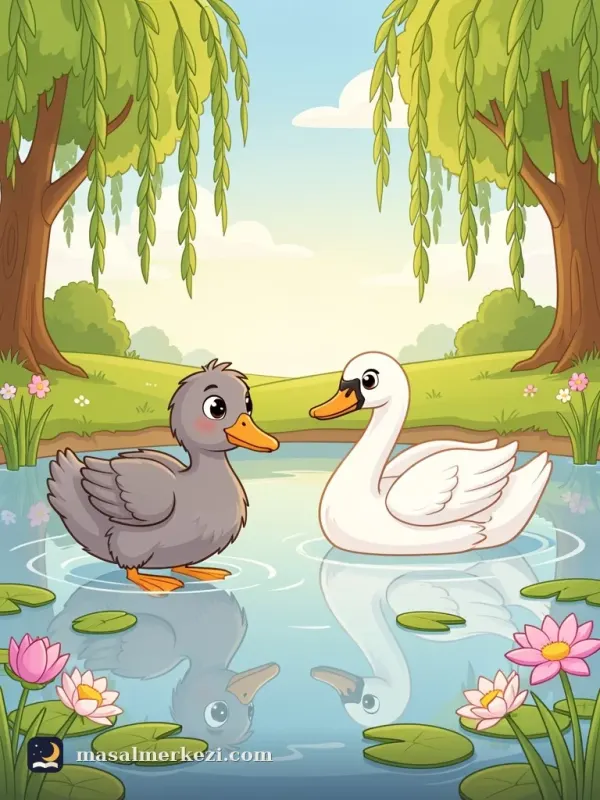
The Wild Swans
A wicked stepmother turns eleven princes into swans; their sister Elisa weaves shirts from stinging nettles to save them and does not speak a single word until the work is done.
Tap a word to see it in Turkish · Long press to translate the whole sentence.
Far away from here, where the swallows fly when it is winter, there lived a king who had eleven sons and one daughter, Elisa. The eleven brothers, being princes, went to school with stars on their breasts and swords at their sides. They wrote on golden slates with diamond pencils and could recite by heart just as well as they could read from a book; you could tell at once that they were princes. Their sister Elisa sat on a little stool of glass and looked at a picture book that had cost half the kingdom.
Oh, how happy these children were! But it was not to last. Their father, who was king of the whole land, married a wicked queen, and this queen was not at all kind to the poor children. They noticed it on the very first day. There was a great feast in the whole palace, and the children were playing at visiting. But instead of getting plenty of cakes and baked apples as usual, the queen gave them a teacup full of sand and said they could pretend it was something to eat.
A week later she sent their little sister Elisa away to the country to live with a peasant family. And before long she told the king so many lies about the poor princes that he did not care about them at all any more. "Fly out into the world and look after yourselves!" said the wicked queen. "Fly like great birds without a voice!" But she could not do them as much harm as she wanted: they turned into eleven beautiful wild swans. With a strange cry they flew out of the palace windows, over the park and the forest, and away.
It was early in the morning; they passed over the place where their sister Elisa lay asleep in the peasant's hut. Here they hovered over the roof, turned their long necks and flapped their wings, but nobody heard or saw them. They had to fly on, up to the clouds and out into the wide world, and they flew away towards a great dark forest that stretched down to the seashore.
Poor little Elisa stood in the peasant's hut playing with a green leaf, for she had no other toy. She pricked a hole in the leaf and looked through it at the sun, and it seemed to her that she saw her brothers' bright eyes. Whenever the warm sun shone on her cheeks, she remembered her brothers' kisses. The days passed, one just like another. When the wind blew through the great rose hedges in front of the house, it whispered to the roses: "Who could be more beautiful than you?" And the roses shook their heads and said, "Elisa."
When she was fifteen she had to go home. When the queen saw how beautiful she was, she grew angry and hated her. She would gladly have turned her into a wild swan like her brothers, but she did not dare to do it at once, because the king wanted to see his daughter. Early in the morning the queen went into a marble bathroom with soft cushions and lovely carpets, took three toads, kissed them and said to the first: "Sit on Elisa's head when she gets into the bath, so that she becomes as sluggish as you." To the second she said, "Sit on her forehead, so that she becomes as ugly as you and her father won't know her." And to the third, "Sit on her heart, so that she is filled with wicked thoughts and suffers from them."
Then she put the toads into the clear water, which at once turned greenish. She called Elisa, undressed her and made her get into the water. As Elisa dipped under, the first toad sat on her hair, the second on her forehead and the third on her heart. But Elisa did not even seem to notice. When she stood up, three red poppies were floating on the water. If the toads had not been poisonous and if the witch had not kissed them, they would have turned into red roses. But still they became flowers, because they had rested on the girl's head and heart. Elisa was so good and innocent that the spell had no power over her.
When the wicked queen saw this, she rubbed Elisa with walnut juice until she was dark brown. She smeared her lovely face with a foul ointment and tangled her beautiful hair. It was impossible to recognise the lovely Elisa. When her father saw her he was shocked and said that this was not his daughter. Nobody knew her except the dog and the swallows, but they were poor animals who could say nothing to anyone.
Poor Elisa wept and thought of her eleven brothers far away. Sadly she slipped out of the palace and walked all day over fields and moors to the great forest. She did not know where to go, but she was very sad and longed for her brothers. She thought that they, like her, had been driven out into the world, and she decided to look for them and find them.
She had been in the forest only a little while when night fell. She had quite lost her way. She lay down on the soft moss, said her evening prayer and leaned her head against a tree stump. It was very still and the air was mild. In the grass and moss around her hundreds of glow-worms shone like green fire. All night long she dreamed of her brothers: they were children again, writing with diamond pencils on golden slates and looking at the picture book that had cost half the kingdom.
When she woke the sun was already high. She could not see it through the thick branches of the trees, but its rays flickered like a golden veil. There was a scent of green things, and the birds almost perched on her shoulders. She heard water splashing; several big springs flowed into a lake with a bottom of shining sand. When Elisa looked into the water she was frightened by her own face, it was so brown and ugly. But when she wet her hand and rubbed her eyes and forehead, her white skin shone again. She took off her clothes and stepped into the cool water, and there was no lovelier king's daughter in the world.
When she had dressed again and braided her long hair, she went to the bubbling spring, drank from her hands and wandered deeper into the forest without knowing where she was going. She thought of her brothers and of the good God, who never forsakes anyone. God made wild apples grow for the hungry, and he showed her a tree whose branches were bent with the weight of its fruit. There she ate her lunch, put props under the branches and went into the darkest part of the forest. It was so quiet that she could hear her own footsteps.
She met an old woman with berries in her basket, and the old woman gave her some. Elisa asked whether she had seen eleven princes riding through the forest. "No," said the old woman, "but yesterday I saw eleven swans with golden crowns on their heads swimming in the river nearby." She led Elisa to a slope, below which a river wound its way. Elisa said goodbye to the old woman and walked along the river bank to where the river flowed out into the great open sea.
The whole beautiful sea lay before the girl, but not a sail and not a boat was to be seen. How was she to go on? She looked at the countless pebbles on the shore; the water had made them all round and smooth. Glass, iron, stones, everything that had been washed up there had been shaped by the water, which was softer than her delicate hand. "The waves keep rolling without tiring, and so they make the hard things smooth. I will not tire either. Thank you for teaching me, clear rolling waves; my heart tells me that one day you will carry me to my dear brothers."
On the seaweed on the shore lay eleven white swan feathers. Elisa gathered them into a bunch. There were drops of water on them; whether they were dew or tears, no one could tell. The shore was lonely, but Elisa did not feel it, because the sea was always changing. As the sun was setting, Elisa saw eleven wild swans with golden crowns on their heads flying towards the land. They glided one behind the other like a long white ribbon. Elisa climbed up the slope and hid behind a bush. The swans landed near her and flapped their great white wings.
As soon as the sun had sunk below the water, the swans' feathers fell away, and there stood eleven handsome princes, Elisa's brothers. Elisa gave a loud cry, for although they had changed a great deal, she knew them, she knew it must be them. She sprang into their arms and called them by their names, and they were overjoyed to see their little sister and to see how tall and beautiful she had grown. They laughed and cried, and they soon understood how cruelly their stepmother had treated them all.
"We brothers," said the eldest, "fly as wild swans as long as the sun is in the sky. When it sets we become human again. So at sunset we must always find a place to set our feet. If we were flying among the clouds when we turned human, we would fall to the bottom of the sea. We do not live here. Across the sea there is a land as beautiful as this one, but the way is very long. We have to cross the great sea, and there is no island on the way where we can spend the night. Only halfway across a little rock rises out of the waves; there is just room for us to stand on it side by side. When the sea is rough, the water sprays over us. But still we thank God for it. There we spend the night in human form; without it we could never see our dear homeland, because our flight takes the two longest days of the year."
"Only once a year may we visit our father's land," he went on, "and we may stay here eleven days. Then we fly over this great forest and see the palace where we were born, where our father lives, and the high tower of the church where our mother is buried. Here the trees and bushes seem like our kin. The wild horses run over the plains as they did in our childhood. The charcoal burners sing the old songs we danced to as children. This is our homeland; this is where we are drawn, and here we have found you, our dear little sister! We may stay here two more days, then we must fly across the sea to a land that is beautiful but not ours. How can we take you with us? We have neither ship nor boat."
"How can I save you?" said their sister. They talked all night and slept only a few hours. Elisa woke to the rustle of swans' wings above her head. Her brothers were swans again and flew away in great circles. But one of them, the youngest, stayed behind with her. He laid his head in her lap, and she stroked his white wings. They stayed together all day. Towards evening the others came back, and when the sun set they took their own shapes again.
"Tomorrow we fly away from here and cannot come back for a whole year. But we can't leave you like this! Have you the courage to come with us? My arm is strong enough to carry you through the forest; won't all our wings together be strong enough to carry you over the sea?" "Yes, take me with you," said Elisa. All night they wove a big, strong net of willow bark and tough rushes. Elisa lay down on the net, and when the sun rose and her brothers turned into wild swans, they took the net in their beaks and flew up to the clouds with their dear sister, who was still asleep. The sun's rays fell right on her face, so one of the swans flew above her head and shaded her with his broad wings.
When Elisa woke they were far from land. She thought she was still dreaming; it was so strange to be carried high over the sea through the air. Beside her lay a branch full of ripe berries and a bunch of sweet roots. Her youngest brother had gathered them and put them beside her. She smiled at him gratefully, because she knew it was he who flew above her head and shaded her with his wings.
All day they flew like a whistling arrow through the air, and yet more slowly than usual, because they were carrying their sister. Bad weather came, and evening was drawing near. Elisa watched the sun sinking with fear, and the lonely rock in the sea was still nowhere to be seen. She thought the swans were beating their wings harder. Oh! If they could not fly faster, it was her fault. When the sun set they would turn human, fall into the sea and drown. Then Elisa prayed to God from the bottom of her heart, but still the rock did not appear. The black cloud came closer, and strong gusts of wind warned of a storm.
The sun was at the edge of the sea. Elisa's heart trembled. Then the swans shot downwards so fast that Elisa thought they were falling, but then they glided again. The sun was half under the water. Then Elisa saw the little rock; it looked no bigger than a seal poking its head out of the water. The sun sank so fast that at last it was no bigger than a star. Then her foot touched the solid ground, and the sun went out like the last spark of a burning piece of paper. She saw her brothers standing around her arm in arm, but there was only just room enough for them and for her. The sea beat against the rock and showered over them like rain. The sky flashed with fire again and again, and thunder rolled upon thunder. But the brothers and sister held hands and sang hymns, and from that they took comfort and courage.
At dawn the air was pure and still. As soon as the sun rose, the swans flew off from the island with Elisa. The sea was still rough. From high above, the white foam on the dark green sea looked like millions of swimming swans. When the sun rose higher, Elisa saw before her, half floating in the air, a mountainous land with shining glaciers. In the middle of the mountains rose a castle that stretched for miles, columns upon columns. Below, palm forests and splendid flowers as big as millstones waved. Elisa asked whether that was the land they were going to, but the swans shook their heads, because what she saw was the ever-changing cloud castle of the Fata Morgana, and they could bring no human there.
At last she saw the real land they were going to. There lovely blue mountains rose with cedar forests, towns and castles. Long before the sun set, Elisa was sitting on a rock in front of a big cave covered with lovely green creepers that looked like embroidered carpets. "Now let's see what you dream here tonight," said her youngest brother, and he showed her the room where she would sleep. "If only I could dream how to save you," said Elisa. That thought never left her. She prayed earnestly to God to help her, and even in her sleep she went on praying.
Then it seemed to her that she was flying high through the air to the cloud castle of the Fata Morgana. The fairy came out to meet her; she was very beautiful and shining, and yet she looked very like the old woman who had given her berries in the forest and told her about the swans with golden crowns. "Your brothers can be saved," said the fairy, "but have you the courage and the endurance? The sea is softer than your delicate hands, yet it changes the shape of hard stones. But it does not feel the pain your fingers will feel. It has no heart, and does not suffer the fear and pain that you must suffer. Do you see this stinging nettle in my hand? Many nettles like this grow around the cave where you sleep. Only those, and the ones that grow in churchyards, will do; remember that. You must pick them, though your hands burn and blister. Crush the nettles with your feet and you will have flax. From it you must spin and weave eleven shirts with long sleeves. Throw them over the eleven wild swans and the spell will be broken. But remember this well: from the moment you begin your work until it is finished, even if it takes years, you must not speak a single word. The first word you speak will pierce your brothers' hearts like a deadly dagger. Their lives hang on your tongue. Remember all this!"
The fairy touched her hand with the nettle; it burned like fire, and Elisa woke with the pain. It was broad daylight, and right beside where she had slept lay a nettle just like the one in her dream. She fell on her knees, thanked God and went out of the cave to begin her work. With her delicate hands she reached for the ugly nettles; they burned like fire, and her hands and arms were covered with big blisters. But she would gladly bear the pain if she could save her dear brothers. She crushed every nettle with her bare feet and spun the green flax.
When the sun set her brothers came, and they were frightened to find her dumb. They thought it was some new spell of their wicked stepmother. But when they saw her hands they understood what she was doing for them, and the youngest brother wept. Where his tears fell, Elisa felt no pain, and the burning blisters vanished. She spent the whole night at her work, because she could not rest until she had saved her dear brothers. The next day, while the swans were away, she sat all alone, but the time had never passed so quickly. One shirt was finished, and she began the second.
Then a hunting horn sounded among the mountains. Elisa was frightened. The sound came nearer; she heard dogs barking. In fear she went into the cave, tied the nettles she had gathered and combed and prepared into a bundle, and sat on it. Just then a big dog came bounding out of the bushes, then another, and another. They barked loudly, ran back and came again. Before long all the hunters stood in front of the cave, and the handsomest of them was the king of that land. He walked towards Elisa; he had never seen so beautiful a girl.
"How did you come here, lovely child?" he asked. Elisa shook her head; she dared not speak, for her brothers' rescue and lives depended on it. She hid her hands under her apron so that the king would not see what she was suffering. "Come with me," said the king, "you can't stay here. If you are as good as you are beautiful, I will dress you in silk and velvet, put a golden crown on your head, and you shall live in my finest palace." Then he lifted her onto his horse in front of him. Elisa wept and wrung her hands, but the king said: "I only want your happiness. One day you will thank me." And he galloped off through the mountains, holding her in front of him, with the hunters behind.
As the sun set, the beautiful royal city with its churches and domes lay before them. The king took her to the palace, where great fountains splashed in lofty marble halls, and the walls and ceilings were covered with splendid paintings. But Elisa had no eyes for any of it; she wept and grieved. Silently she let the women dress her in royal robes, braid pearls into her hair and draw fine gloves over her blistered fingers. She stood there in all that splendour, so dazzlingly lovely that the court bowed even lower before her. The king chose her for his bride, but the archbishop shook his head and whispered that this lovely girl from the forest was a witch who had dazzled the king's eyes and stolen his heart.
But the king would not listen. He ordered music to play, the costliest dishes to be served and the loveliest girls to dance around her. He led Elisa through fragrant gardens into magnificent halls, but not a smile appeared on her lips or in her eyes; only sorrow lived there. Then the king opened the door of a little room next to the one where she was to sleep. It was hung with costly green carpets and looked just like the cave where she had been. On the floor lay the bundle of flax she had spun from the nettles, and from the ceiling hung the shirt she had finished. One of the hunters had brought all these along out of curiosity.
"Here you can dream that you are back in your old home," said the king. "Here is the work you were busy with. In the midst of all this splendour it will amuse you to think of those old days." When Elisa saw the things so close to her heart, a smile appeared on her lips and the colour came back to her cheeks. She thought of her brothers' rescue and kissed the king's hand; he pressed her to his heart and ordered all the church bells to ring for the wedding. The lovely dumb girl from the forest became queen of the land.
The archbishop whispered wicked words into the king's ear, but they did not reach his heart. The wedding took place. The archbishop himself had to put the crown on her head, and out of spite he pressed the narrow circlet so hard on her forehead that it hurt. But there was a heavier circlet around her heart, her grief for her brothers; she did not feel the pain in her body. Her mouth was closed; a single word would cost her brothers their lives. But in her eyes there was deep love for the good, handsome king who did everything he could to please her. Every day she grew fonder of him. Oh, if only she could trust him and tell him her sorrows! But she had to stay dumb and finish her work in silence. So at night she slipped away from his side into her little room that looked like the cave, and there she wove one shirt after another. But when she began the seventh, she had no flax left.
She knew that the nettles she could use grew in the churchyard, but she had to pick them herself. How was she to get there? "Oh, what is the pain in my fingers compared with what my heart suffers?" she thought. "I must risk it. The good God will protect me." With a trembling heart, as if she were doing something wicked, she crept down into the garden in the moonlit night, through the long avenues and the empty streets to the churchyard. There on one of the big tombstones sat a group of frightful witches. Elisa had to pass them. The witches stared at her with dreadful eyes, but Elisa said her prayer, gathered the burning nettles and carried them back to the palace.
Only one person had seen her: the archbishop. He was awake while everyone else slept. Now he thought he had been right about the queen; there was something strange about her, she was a witch who had bewitched the king and all the people. In the confessional he told the king what he had seen and what he feared. Two big tears rolled down the king's cheeks, and he went home with doubt in his heart. At night he pretended to sleep, but no sleep came to his eyes. He saw how Elisa got up; it happened every night, and each time the king followed her quietly and saw her go into her little room.
Day by day the king's face grew darker. Elisa saw it but did not understand why. It frightened her, and on top of that there was the pain she suffered in her heart for her brothers. Her hot tears fell on the royal velvet and purple and lay there like sparkling diamonds. All who saw her rich splendour wished they were queen. Meanwhile she had nearly finished her work; only one shirt was missing, but again she had no flax and no nettles. Once more, just once more, she had to go to the churchyard and pick a few handfuls. She was afraid when she thought of the lonely walk and the dreadful witches, but her will was as firm as her trust in God.
Elisa went, but the king and the archbishop followed her. They saw her disappear through the churchyard gate, and when they came closer, there on the tombstone sat the witches Elisa had seen. The king turned away, for he thought that the girl whose head had rested on his breast that very evening was one of these witches. "Let the people judge her," he said. And the people condemned her to be burned.
From the splendid royal halls she was taken to a dark, damp dungeon, where the wind whistled through the barred window. Instead of velvet and silk they gave her the bundle of nettles she had gathered; she could lay her head on that. The coarse, burning shirts she had woven were to be her blanket. But they could have given her nothing more precious. She began her work again and prayed to God. Outside, the street boys sang songs mocking her; there was no one to say a kind word to her.
Towards evening there was a rustle of swan's wings at the bars. It was her youngest brother; he had found his sister. She sobbed aloud for joy, though she knew that the coming night would perhaps be the last she would live. Still, her work was almost done, and her brothers were here. The archbishop came to be with her in her last hour, as he had promised the king. But Elisa shook her head and with looks and signs begged him to go. That night she must finish her work, or all her pain, tears and sleepless nights would have been in vain. The archbishop left her with wicked words. But poor Elisa knew she was innocent and went on with her work.
The little mice ran about on the floor, dragging the nettles to her feet to help her a little. The thrush perched on the bars of the window and sang all night as sweetly as it could, so that Elisa would not lose heart.
An hour before dawn, before the sun rose, the eleven brothers stood at the palace gate and asked to be taken to the king. But they were told this was impossible; it was still night, the king was asleep and they dared not wake him. They begged, they threatened; the guard came, and at last the king himself came out and asked what it was all about. At that moment the sun rose, and the brothers were seen no more, but eleven white swans flew over the palace.
All the people streamed out of the city gate to see the witch burned. An old horse pulled the cart in which she sat. They had dressed her in a smock of coarse sacking. Her lovely hair hung loose around her lovely head, her cheeks were deathly pale, and her lips moved silently while her fingers went on weaving the green flax. Even on her way to death she would not leave the work she had begun. Ten shirts lay at her feet, and she was working on the eleventh. The crowd jeered at her: "Look at the witch, how she mutters! She has no prayer book in her hands; there she sits with her ugly sorcery! Let's tear it from her into a thousand pieces!"
They all rushed towards her and wanted to tear up the nettle shirts. But eleven white swans came flying, settled around her on the cart and beat their great wings. The crowd drew back in fear. "It's a sign from heaven! She must be innocent!" many whispered, but they dared not say it aloud. The executioner took her by the hand; then Elisa quickly threw the eleven shirts over the swans, and there stood eleven handsome princes. But the youngest had a swan's wing instead of an arm, because one sleeve of his shirt was missing; she had not been able to finish it.
"Now I may speak!" she said. "I am innocent!" When the people saw this, they bowed before her as before a saint. But Elisa, worn out with all the fear, pain and sorrow, sank lifeless into her brothers' arms. "Yes, she is innocent!" said the eldest brother, and he told everything that had happened. While he spoke, a fragrance spread like that of millions of roses, for every stick of the woodpile had taken root and put out branches; it had become a great, tall hedge full of fragrant red roses. And at the very top a bright white flower shone like a star. The king picked it and laid it on Elisa's breast. Then she woke with peace and happiness in her heart.
All the church bells began to ring by themselves, and the birds came in flocks. Back to the palace went such a wedding procession as no king had ever seen.
The tale ends here. Sleep well.
The Wild Swans is a children's tale from Hans Christian Andersen, suitable for ages 7-12 and about 24 minutes long. Read it free on Masal Merkezi, play a lullaby or nature sound in the background, tap any word to see its Turkish meaning and save it to your favorites. For similar tales browse the Andersen Fairy Tales category.
Sign up and your favorites and reading list follow you on every device.