Thumbelina
A girl no bigger than a thumb, born from a tulip bud, reaches the land of the flowers after a long journey.
Tap a word to see it in Turkish · Long press to translate the whole sentence.
Once upon a time there was a woman who longed for a tiny little child, but she had no idea where to find one. At last she went to an old witch and said to her: "I would so like to have a little child. Can you tell me where I might find one?" "Oh, that's easy enough," said the witch. "Here's a barleycorn. But it isn't the kind that grows in the farmer's field or that the hens eat. Plant it in a flowerpot, and you'll see what happens."
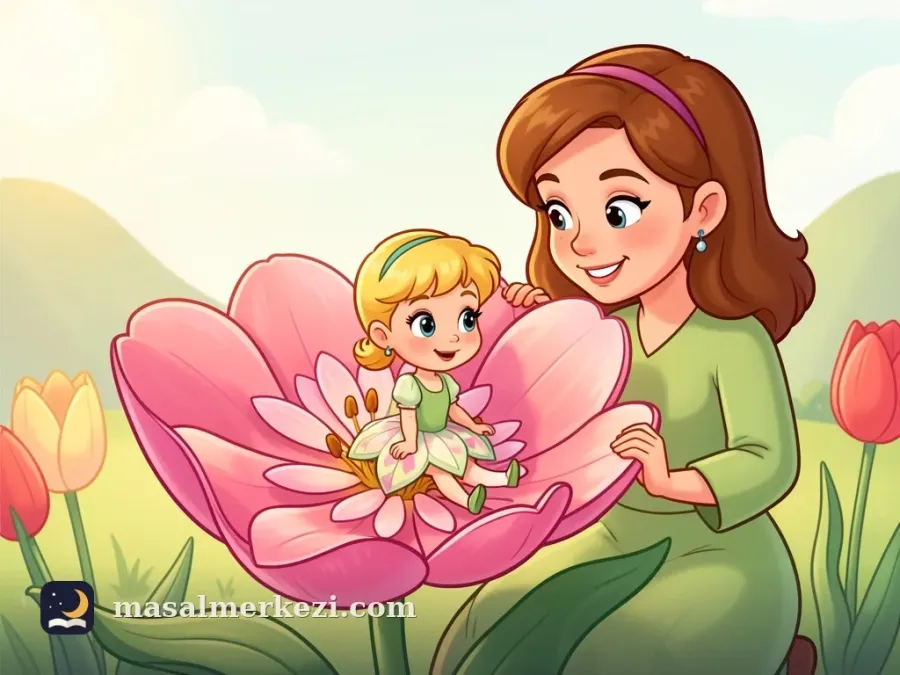
"Thank you," said the woman, and she gave the witch twelve pennies. Then she went home and planted the barleycorn. At once a big, beautiful flower came up; it looked like a tulip, but its petals were tightly closed, as if it were still a bud. "What a lovely flower," said the woman, and she kissed its beautiful red and yellow petals. As she kissed it, the flower opened with a "pop". It really was a tulip; but right in the middle of the flower, on the green centre, sat a tiny little girl. She was very delicate and pretty, but no bigger than a thumb. So they called her Thumbelina.
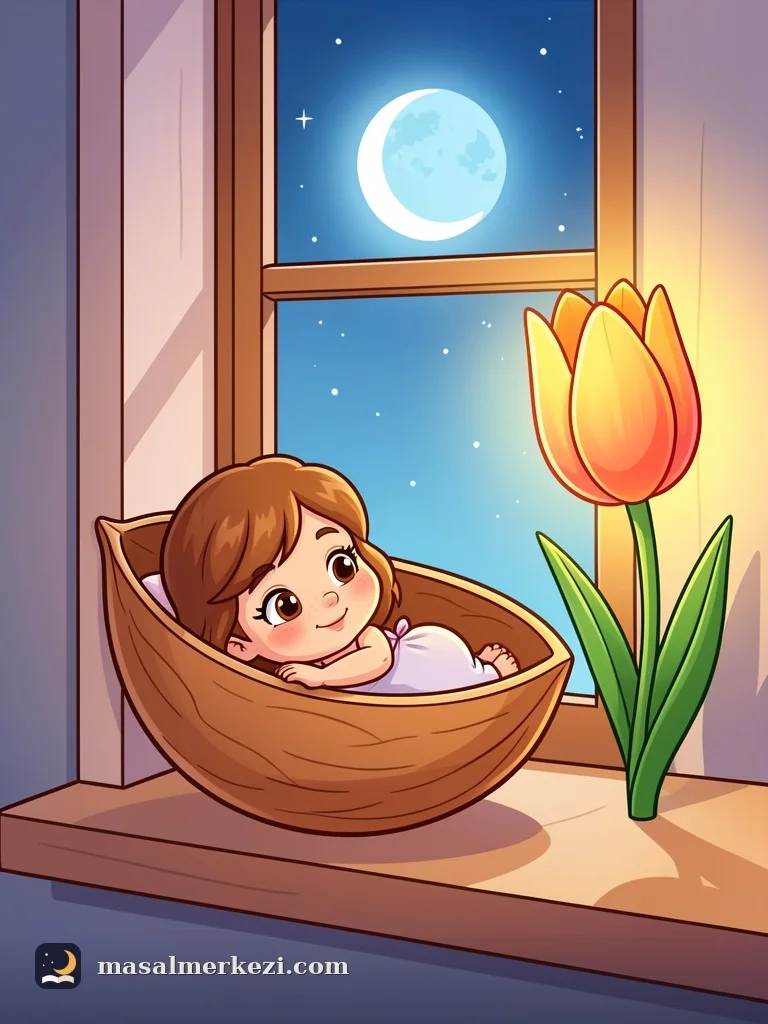
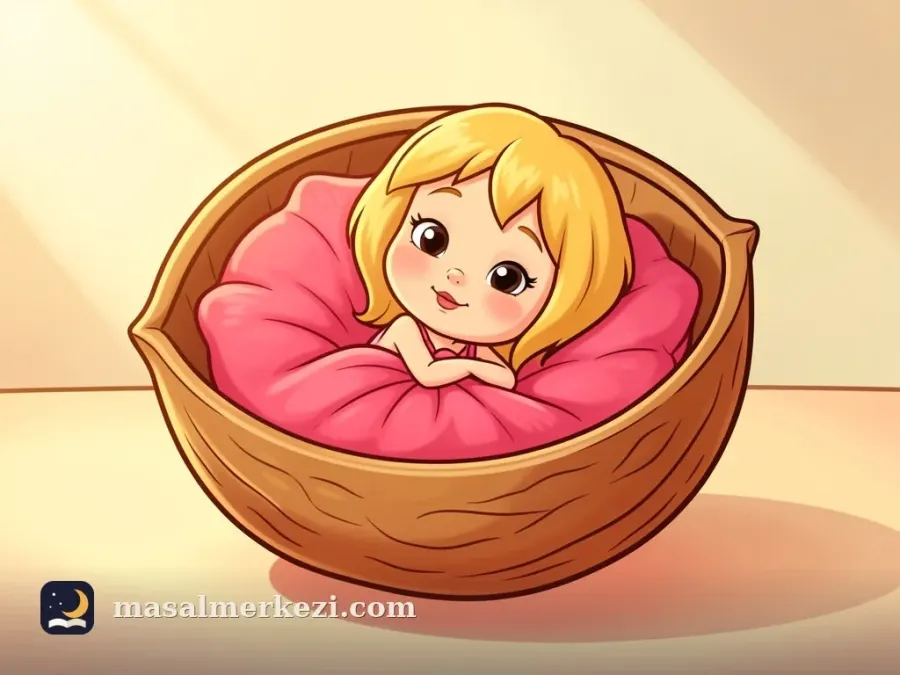
A beautifully polished walnut shell was her cradle, blue violet petals were her mattress, and a rose petal was her quilt. She slept there at night, and in the daytime she played on the table. The woman put a plate of water on the table and arranged a garland of flowers around its edge, with their stalks in the water. On the water floated a big tulip petal. Thumbelina could sit on this petal and row from one side of the plate to the other, using two white horsehairs as oars. It looked very pretty. And she sang, too, in a voice so fine and sweet that no one had ever heard anything like it.
One night, as Thumbelina lay in her pretty bed, an ugly toad came hopping in through a broken pane in the window. The toad was big and wet and ugly. It jumped straight onto the table where Thumbelina lay asleep under the rose petal. "She would make a lovely wife for my son," said the toad, and it picked up the walnut shell in which Thumbelina was sleeping and hopped out of the window into the garden.
In the garden flowed a broad stream. The bank was swampy and muddy, and there the toad lived with her son. He was ugly too, just like his mother. When he saw the pretty little girl in the walnut shell, all he could say was, "Croak, croak, brek-kek-kex." "Don't talk so loud, or she'll wake up," said the old toad. "She might run away from us, for she's as light as swan's down. Let's put her on one of the big water-lily leaves in the middle of the stream. She's so light and small that it will be like an island to her. She can't escape from there. Meanwhile we'll get the fine room under the mud ready, where you two will live."
When morning came, Thumbelina woke up. When she saw where she was, she began to cry bitterly, for there was water all around the big green leaf, and she could not get to land at all. The old toad was sitting in the mud, decorating the room with rushes and yellow water lilies; she wanted to make it nice for her new daughter-in-law. Then she swam with her ugly son out to the leaf where Thumbelina was standing; they wanted to fetch her pretty bed to put in the bridal chamber. The old toad bowed low in the water before her and said: "Here is my son, who will be your husband. You'll live very comfortably down in the mud." "Croak, croak, brek-kek-kex!" was all her son could say.
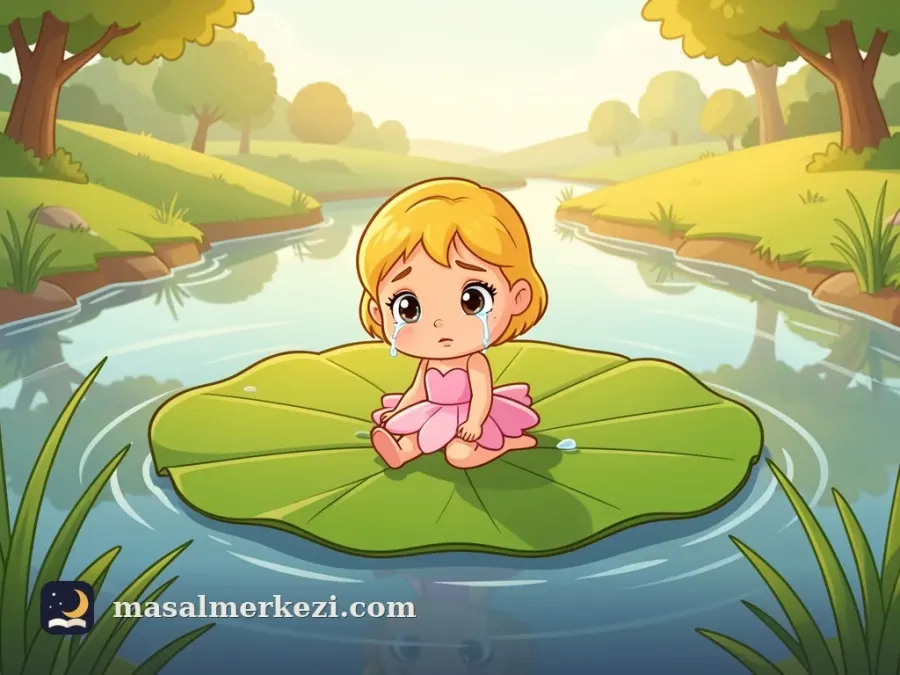
The toads took the walnut shell and swam away. Thumbelina sat on the green leaf and wept, for she did not want to live in the nasty toad's house or marry her ugly son. The little fish swimming in the water had seen the toad and heard what she said. They put their heads out of the water to look at the little girl. As soon as they saw her, they thought she was very pretty and felt sorry that such a pretty girl should have to go to the ugly toad. No, that must never happen! They gathered under the water around the stalk of the leaf and gnawed it through with their teeth. Away floated the leaf down the stream with Thumbelina on it, far away where the toad could not reach her.
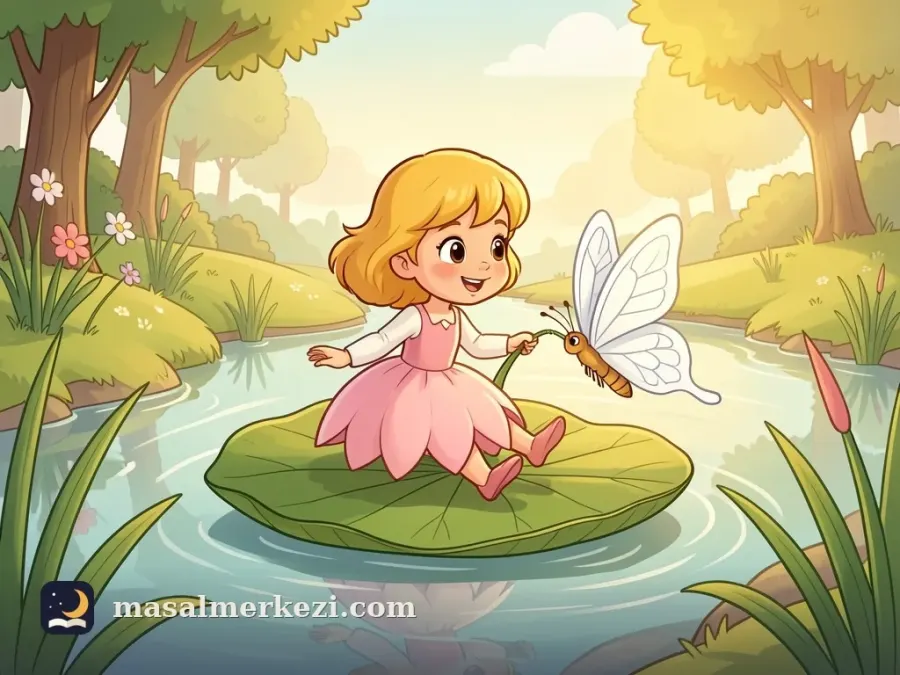
Thumbelina floated past many places. The little birds in the bushes saw her and sang, "What a pretty little girl!" The leaf carried her further and further away, and so she came to a foreign land. A lovely little white butterfly kept fluttering around her and at last settled on the leaf, for it liked Thumbelina very much. And Thumbelina was very happy; now the toad could not reach her, and the places she was passing were so beautiful. The sun shone on the water, and the water sparkled like shining gold. Thumbelina took off her sash, tied one end to the butterfly and the other to the leaf, and the leaf went much faster.
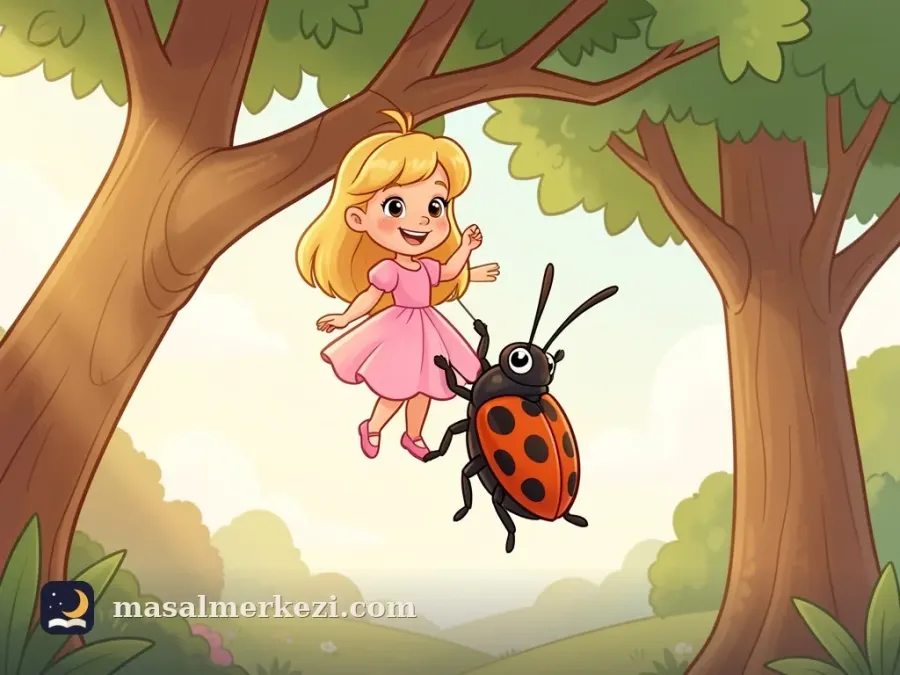
Just then a big cockchafer came flying by and saw her. At once he seized her around her slender waist with his claws and flew up into a tree with her. The green leaf floated on down the stream, and the butterfly with it, for it was tied to the leaf and could not get free. Goodness, how frightened poor Thumbelina was when the cockchafer carried her up into the tree! But most of all she was sorry for the lovely white butterfly she had tied to the leaf, for if it could not get free, it would starve. But the cockchafer did not care about that. He sat with her on the biggest leaf of the tree, gave her honey from the flowers to eat and told her she was very pretty, although she did not look a bit like a cockchafer.
Then all the cockchafers who lived in the tree came to visit. They looked at Thumbelina, and the young lady cockchafers waved their feelers and said, "She only has two legs; how pitiful!" "She has no feelers!" "Her waist is so thin, ugh, she looks like a human!" "How ugly she is!" said all the lady cockchafers. And yet Thumbelina was very pretty. The cockchafer who had carried her off thought so too, but when everyone said she was ugly, he finally believed it and did not want her any more. He flew down from the tree with her and set her on a daisy. Thumbelina cried because she was so ugly that even the cockchafers did not want her. And yet she was the loveliest creature you could imagine, as delicate and bright as the most beautiful rose petal.
All summer long poor Thumbelina lived quite alone in the great forest. She wove herself a bed of grass stalks and hung it under a big burdock leaf to keep off the rain. She ate the honey from the flowers and drank the dew from the leaves every morning. So the summer and autumn passed. But then came winter, the long, cold winter. All the birds that had sung so sweetly to her flew away, and the trees and flowers withered. The big burdock leaf she had lived under curled up and turned into a dry, yellow stalk. Thumbelina was terribly cold, for her clothes were torn and she was so delicate and small. Poor Thumbelina was going to freeze to death. It began to snow, and every snowflake that fell on her was like a whole shovelful thrown on one of us, for we are big and she was only as tall as a thumb. She wrapped herself in a dry leaf, but it split down the middle and did not warm her. She shivered with cold.
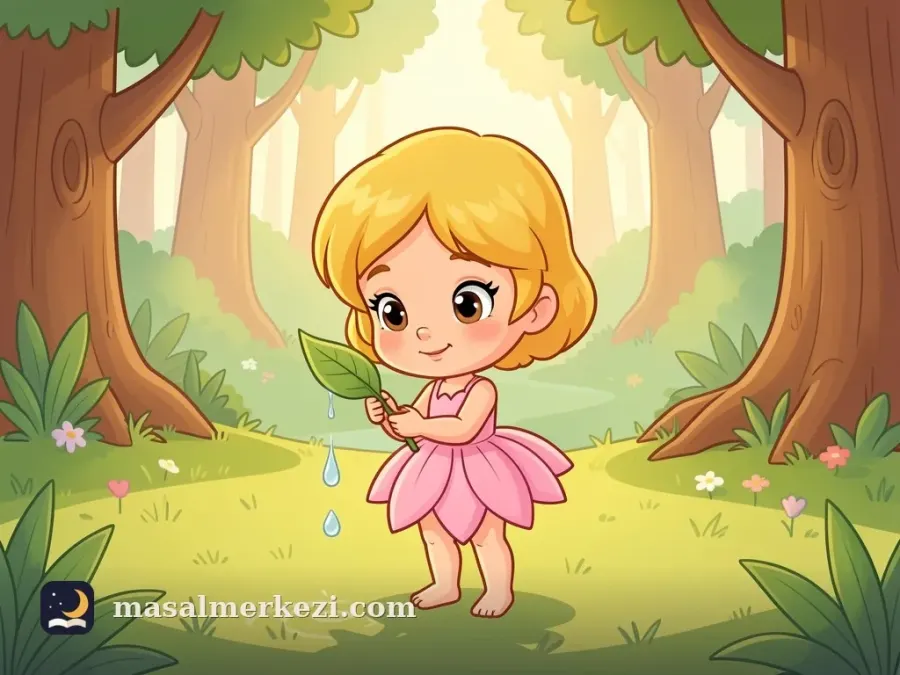
Close to the edge of the forest lay a big cornfield. But the corn had long been harvested; only the bare, dry stubble stuck up out of the frozen ground. To her it was like a forest, and it was very hard going. Shivering, she came to the door of a field mouse. The field mouse had a little hole under the stubble. There she lived warm and snug, with a whole room full of corn, a fine kitchen and a pantry. Poor Thumbelina stood at the door like a beggar girl and asked for a single grain of barley, for she had had nothing to eat for two days.
"You poor little thing," said the field mouse, for she was really a kind old field mouse. "Come into my warm room and have something to eat with me." She took a liking to Thumbelina and said: "You can stay with me all winter, but you must keep my room clean and tidy and tell me stories, for I'm very fond of stories." Thumbelina did what the kind old field mouse asked and lived very well there.
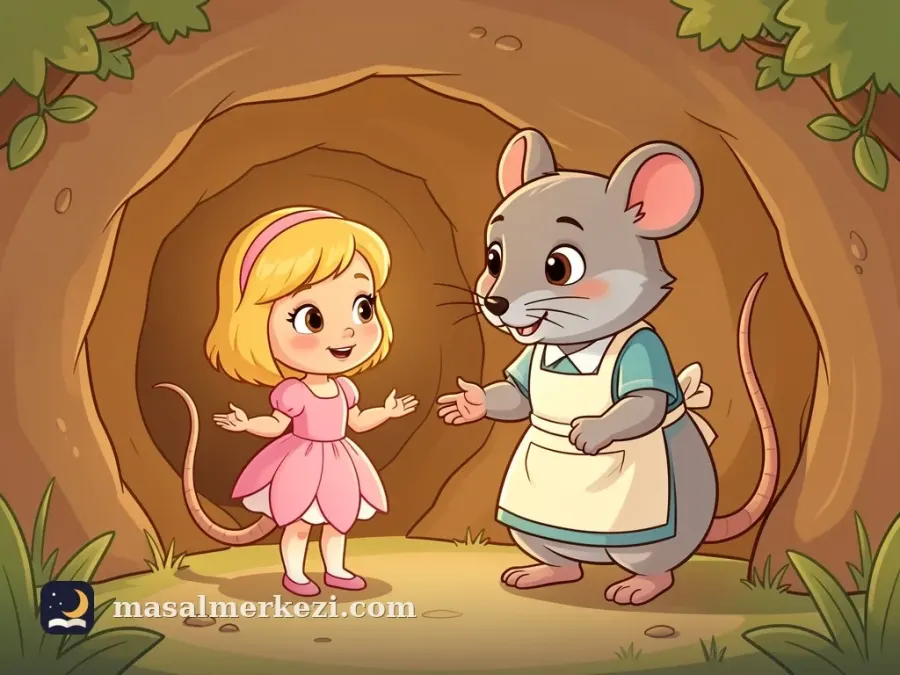
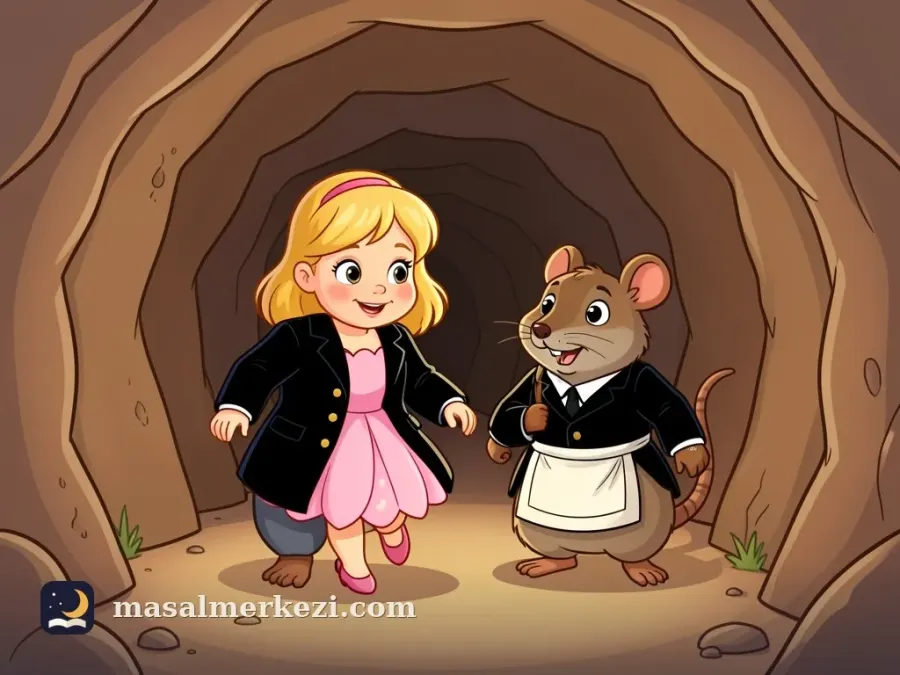
"We'll soon have a visitor," said the field mouse one day. "My neighbour comes to see me once a week. He's even better off than I am; he has big rooms and wears a beautiful black velvet coat. If you could marry him, you'd want for nothing. But he can't see. You must tell him the very best stories you know." But Thumbelina did not care for this at all, for the neighbour was a mole. The mole came to visit in his black velvet coat. He was very rich and very learned, but he could not stand the sun and the beautiful flowers and spoke badly of them, because he had never seen them. Thumbelina had to sing. Because of her lovely voice, the mole fell in love with her, but he said nothing, for he was a very sober-minded man.
The mole had dug a long tunnel from his house to the field mouse's, and he gave Thumbelina and the field mouse permission to walk in it whenever they liked. But he told them not to be afraid of the dead bird lying in the tunnel. The mole took a piece of rotten wood in his mouth, which shines like fire in the dark, and went ahead of them, lighting up the long, dark tunnel. When they came to the place where the dead bird lay, the mole pushed his broad nose up against the ceiling and shoved the earth aside, so that a big hole appeared and the light came in. In the middle of the floor lay a dead swallow, its lovely wings pressed against its sides and its legs and head tucked under its feathers. The poor bird had obviously died of cold.
Thumbelina felt very sorry for it, for she loved all the little birds that had sung and twittered so beautifully for her all summer. But the mole kicked it with his short legs: "It won't chirp any more. How miserable it must be to be born a little bird! Thank goodness none of my children will ever be a bird. A bird like that has nothing but its 'tweet-tweet', and in winter it has to starve." Thumbelina said nothing. But when the two of them had turned their backs on the bird, she bent down, parted the feathers over its head and kissed its closed eyes. "Perhaps it was this one that sang so beautifully to me in the summer," she thought. "How much happiness it gave me, the dear, pretty bird."
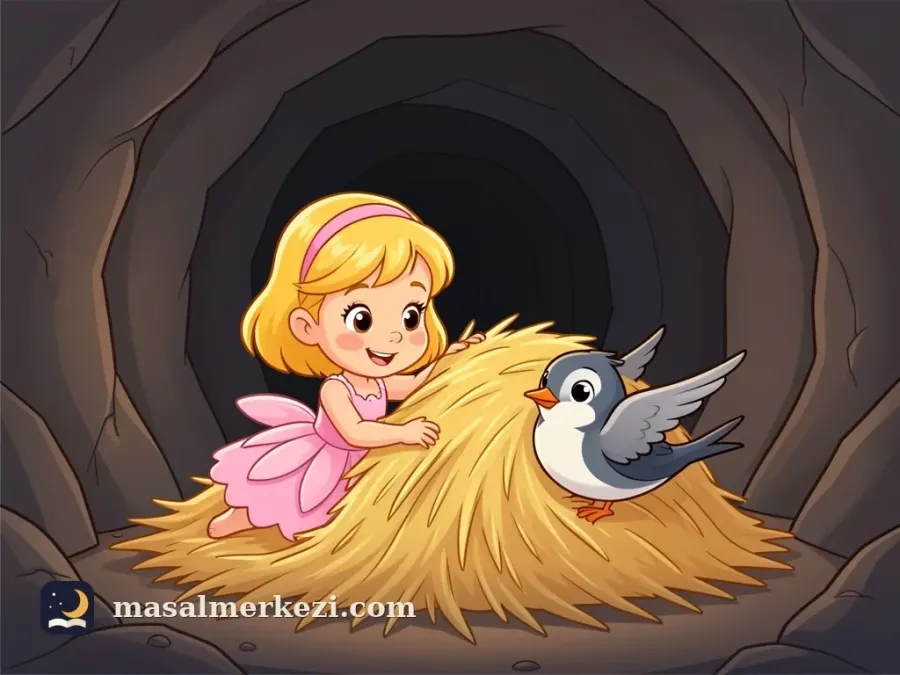
That night Thumbelina could not sleep at all. She got out of bed and wove a big, beautiful blanket of hay. She carried it to the dead bird and spread it over it, and she laid soft cotton she had found in the field mouse's room at its sides, so that it would lie warm on the cold ground. "Goodbye, pretty bird," she said. "Goodbye, and thank you for your lovely songs in the summer, when all the trees were green and the sun shone so warmly on us." Then she laid her head on the bird's breast. But at once she was frightened, for something seemed to be beating inside. It was the bird's heart. The bird was not dead, only numb with cold; now that it was warm, it was coming back to life.
The next night Thumbelina crept out to the bird again. It was alive but very weak; it could only open its eyes for a moment to look at Thumbelina, who was standing there with a piece of rotten wood in her hand for a light. "Thank you, pretty little child," said the sick swallow. "I've been so nicely warmed. Soon I'll be strong again and able to fly out into the warm sunshine." "Oh," said Thumbelina, "it's so cold outside. It's snowing and freezing. Stay in your warm bed, and I'll look after you." All winter long Thumbelina looked after the swallow in secret, and neither the mole nor the field mouse knew anything about it.
When spring came and the sun warmed the earth, the swallow said goodbye to Thumbelina. Thumbelina saw the sun shining in through the hole the mole had made. The swallow asked her: "Will you come with me? You can sit on my back, and we'll fly away into the green forest." But Thumbelina knew it would make the old field mouse very sad if she left, so she said, "No, I can't." "Goodbye, goodbye, you good, pretty girl," said the swallow, and it flew out into the sunshine. Thumbelina watched it go, and her eyes filled with tears, for she loved the poor swallow very much.
"This summer you must get your trousseau ready," said the field mouse one day, "for the mole wants to marry you." Thumbelina had to spin, and the field mouse hired four spiders to weave day and night. Every evening the mole came and said that when the summer was over and the sun was no longer hot enough to bake the earth as hard as stone, they would have the wedding. Thumbelina was not at all happy, for she did not like the tiresome mole one bit. Every morning when the sun rose, and every evening when it set, she crept out of the door, and when the wind parted the ears of corn, she could see the blue sky. How bright and beautiful it was outside! She longed so much to see her dear swallow again.
When autumn came, Thumbelina's trousseau was ready. "In four weeks you'll have your wedding," said the field mouse. Thumbelina cried and said she did not want to marry the tiresome mole. "Nonsense," said the field mouse. "Don't be stubborn, or I'll bite you with my white tooth. He's a very good husband. Even the queen doesn't have a black velvet coat as fine as his. His kitchen and pantry are full. You should thank God for him."
The wedding day came. The mole had come to fetch Thumbelina; she was to live with him deep under the ground and never see the warm sun again, for the mole did not like the sun. The poor girl was very sad. She went out of the field mouse's door to say goodbye to the sun. "Goodbye, bright sun!" she said, and lifted her arms up high. She put her arms around a little red flower that was blooming there: "Give my love to the dear swallow, if you ever see it."
"Tweet, tweet!" At that very moment she heard a sound above her head. She looked up, and there was the swallow flying by. When it saw Thumbelina, it was overjoyed. Thumbelina told it that she did not want to marry the ugly mole and live deep under the earth where the sun never shines, and she cried. "The cold winter is coming," said the swallow, "and I'm flying far away to warm countries. Will you come with me? You can sit on my back. Tie yourself on tight with your sash, and we'll fly far away from the ugly mole and his dark house, over the mountains, to the warm countries where the sun shines more beautifully than here, where it's always summer and lovely flowers bloom. Come with me, dear little Thumbelina. You saved my life when I lay frozen in the dark earth."
"Yes, I'll come with you," said Thumbelina, and she climbed onto the bird's back, set her feet on its outspread wings and tied her sash to one of its strongest feathers. The swallow flew up into the air, over forests and seas, high over the great mountains always covered with snow. When Thumbelina felt cold in the chilly air, she crept under the bird's warm feathers, just poking out her little head to see all the beautiful things below.

At last they came to the warm countries. The sun shone far more brightly there than here. The sky seemed twice as high. Along the ditches and hedges grew the most beautiful green and blue grapes. Lemons and oranges hung in the woods, and myrtle and mint gave off their fragrance. The swallow flew further still, and everything became more and more beautiful. Under lovely green trees beside a blue lake stood an old palace of snow-white marble. Vines wound around its tall pillars, and at the top there were many swallows' nests. One of them was the nest of the swallow carrying Thumbelina.
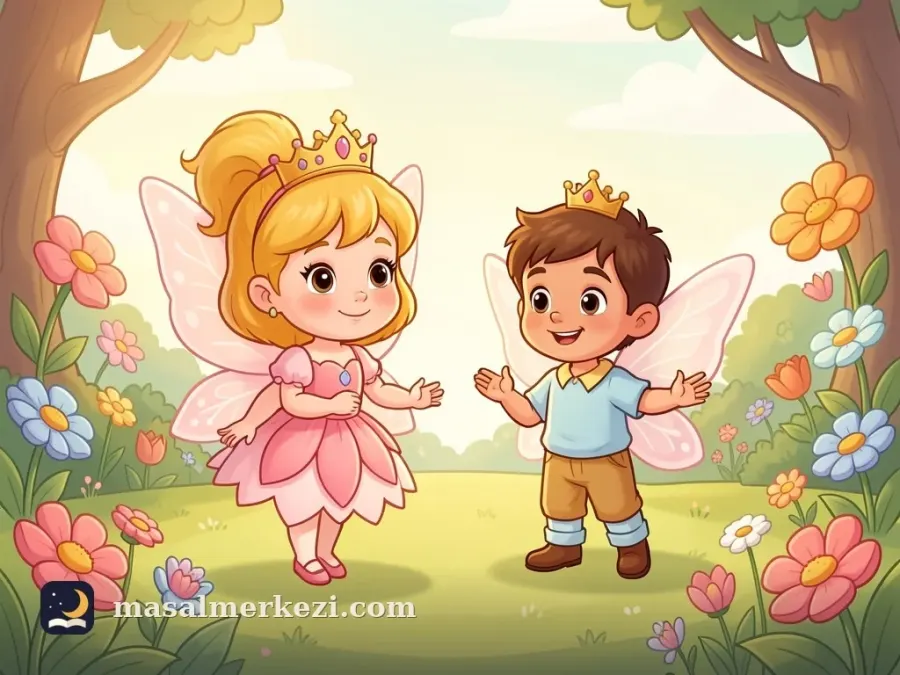
"This is my home," said the swallow. "But if you choose one of the beautiful flowers growing down there, I'll put you in it, and you can live as you please." "How lovely," said Thumbelina, and she clapped her little hands. On the ground lay a great white marble pillar that had fallen and broken into three pieces, and between the pieces grew the most beautiful white flowers. The swallow flew down with Thumbelina and set her on one of the broad petals. But how surprised she was! In the middle of the flower sat a little man, as white and transparent as if he were made of glass. He wore the loveliest golden crown on his head and the most delicate wings on his shoulders, and he was no bigger than Thumbelina. He was the angel of the flower. In every flower there lived such a little man or woman, but he was the king of them all.
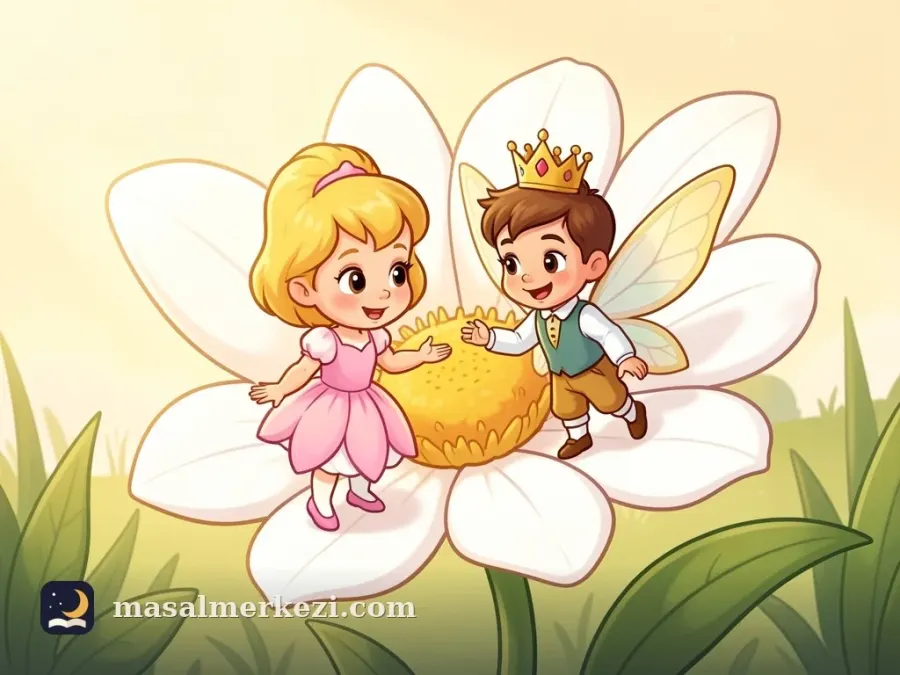
"Goodness, how handsome he is!" whispered Thumbelina to the swallow. The little prince was very frightened of the swallow, for he was so small and delicate that it seemed a giant bird to him. But when he saw Thumbelina, he was overjoyed; she was the prettiest girl he had ever seen. He took the golden crown from his own head and put it on hers, asked her name and asked whether she would be his wife, for then she would be queen of all the flowers. Yes, that would be a very different husband from the toad's son or the mole with his black velvet coat! Thumbelina said yes.
Out of every flower came a lady or a gentleman, so graceful that it was a pleasure to look at them. Each of them brought Thumbelina a present, but the best of all was a pair of lovely wings from a big white fly. They fastened them to Thumbelina's back, and she too could fly from flower to flower. There was great rejoicing everywhere. And the swallow sat up in its nest and sang for them as well as it could, but deep in its heart it was a little sad, for it loved Thumbelina very much and never wanted to be parted from her.
"You shan't be called Thumbelina any more," said the flower angel to her. "That's an ugly name, and you are so beautiful. We'll call you Maia." "Goodbye, goodbye," said the little swallow, and it flew away from the warm countries, far away back to Denmark. There it had a little nest above the window of a man who knew how to tell fairy tales. "Tweet, tweet," it sang to him. And that is how we came to know the whole story.
The tale ends here. Sleep well.
Thumbelina is a children's tale from Hans Christian Andersen, suitable for ages 4-9 and about 17 minutes long. Read it free on Masal Merkezi, play a lullaby or nature sound in the background, tap any word to see its Turkish meaning and save it to your favorites. For similar tales browse the Bedtime Stories category.
Sign up and your favorites and reading list follow you on every device.