The Flying Trunk
A merchant's son who has spent his whole fortune flies in a magic trunk to the land of the Turks and tells the princess stories; but his own vanity sets everything on fire.
Tap a word to see it in Turkish · Long press to translate the whole sentence.
There was once a merchant who was so rich that he could have paved the whole street, and a little alley besides, with silver coins. But he did not do it; he knew better ways to use his money. If he spent a penny, he got a gold coin back. That was the kind of merchant he was, and then he died.
His son inherited all this money. He lived merrily, went to masked balls every night, made kites out of banknotes and skimmed gold coins across the sea instead of stones. So the money could easily go, and it did. At last he had nothing left but four pennies, a pair of slippers and an old dressing gown. Now his friends no longer cared about him, because they couldn't walk down the street with him. But one of them, a kind-hearted one, sent him an old trunk and said, "Pack up!" Well, that was easy to say, but he had nothing to pack. So he sat in the trunk himself.
It was a strange trunk. If you pressed the lock, the trunk could fly. And that is what he did, and whoosh! the trunk flew up the chimney with him, high above the clouds, farther and farther away. Whenever the bottom of the trunk creaked he was frightened, for if it broke he would have a nasty fall. Heaven forbid! And so he came to the land of the Turks. He hid the trunk in the forest under the dry leaves and went into the town. He could do that, because the Turks all went about in dressing gowns and slippers just like him.
He met a nurse with a little child. "Listen, Turkish nurse," he said, "what is that big castle outside the town with its windows so high up?" "The sultan's daughter lives there!" said the woman. "It has been foretold that she will be very unhappy because of a sweetheart. That's why nobody may visit her unless the king and queen are there." "Thank you!" said the merchant's son. He went back to the forest, sat in his trunk, flew onto the roof and slipped in through the window to the princess.
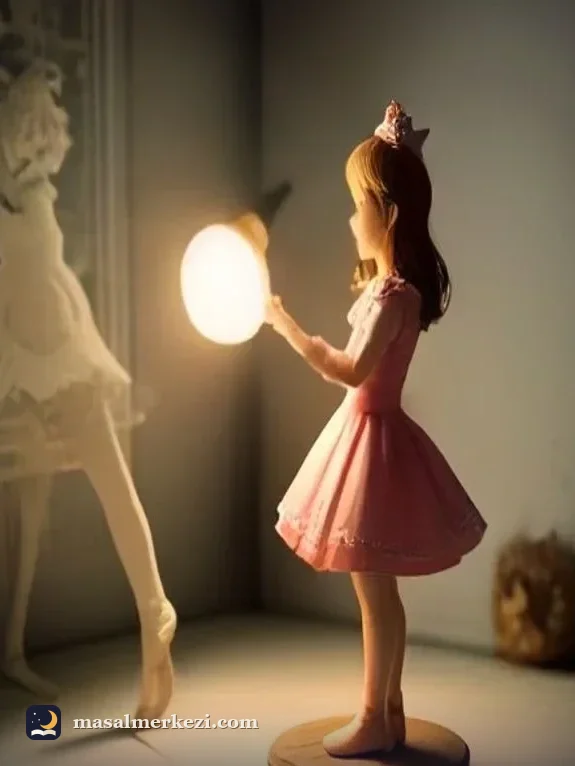
The princess lay asleep on the sofa. She was so lovely that the merchant's son could not help kissing her. She woke and was very frightened, but he told her he was the Prophet of the Turks and had come to her through the air, and she liked that very much. They sat side by side, and he told her about her eyes: they were the loveliest dark lakes, where thoughts swam like mermaids. He told her about her forehead: it was a snowy mountain with the most splendid halls and pictures. And he told her about the storks that bring sweet little children.
Yes, those were lovely stories! Then he asked the princess to marry him, and she said yes at once. "But you must come on Saturday," she said, "when the king and queen come to tea with me! They will be very proud that I am marrying the Prophet of the Turks. But be sure to have a fine story to tell them, because they both love stories. My mother likes them moral and noble, and my father likes merry ones that make you laugh." "Yes, I shall bring no wedding present but a story," he said. Then they parted, but the princess gave him a sword set with gold coins, and he could make very good use of that.
He flew away, bought a new dressing gown and then sat in the forest thinking up a story. It had to be ready by Saturday, and that was not at all easy. At last he had it ready, and Saturday came. The king, the queen and the whole court were waiting for him at tea with the princess. They gave him a very warm welcome.
"Will you tell us a story?" said the queen. "One that is deep and instructive." "But one that makes us laugh too," said the king. "Certainly," said he, and began. Now listen carefully:
"There was once a bundle of matches. They were very proud of their high birth. Their family tree, the great pine tree of which each of them was a little splinter, had been a great old tree in the forest. Now the matches lay on the shelf between a tinderbox and an old iron pot, and they told them about their youth. 'Yes, when we were on the green branches,' they said, 'we really were on green branches! Every morning and evening there was diamond tea, which is called dew. All day long we had sunshine, when the sun was shining; and all the little birds had to tell us stories. We could see that we were very rich, for the other trees were dressed only in summer, but our family had green clothes in winter and summer alike. But then the woodcutters came, and that was a great revolution; our family was broken up. The head of the family became the mainmast of a fine ship; he can sail around the world if he likes. The other branches went elsewhere, and our task is to give light to the lower classes. That is how we, people of quality, came to be in the kitchen.'
'My fate has been different,' said the iron pot that stood beside the matches. 'Ever since I came into the world I have been scoured and boiled many times! I care for what is solid and lasting, and I am really the first in this house. My only joy is to stand clean and tidy on the shelf after dinner and have a sensible talk with my friends. But apart from the water bucket, which goes down to the yard sometimes, we live always indoors, within four walls. Our only news comes from the market basket, and it talks very uneasily about the government and the people. Why, the other day an old jug was so frightened that it fell down and broke to pieces. It was very free-thinking.' 'You're talking too much now,' said the tinderbox, and it struck its steel so that sparks flew. 'Aren't we going to have a merry evening?'
'Yes, let's talk about which of us is the most aristocratic,' said the matches. 'No, I don't like talking about myself,' said the earthenware pot. 'Let's have an evening's entertainment! I'll begin; I'll tell about something everyone has experienced, so you can easily put yourselves in my place, and that is very amusing. By the Baltic Sea, near the Danish beech trees...' 'What a lovely beginning!' said all the plates. 'That will certainly be a story we like!' 'Yes, there I spent my youth in a quiet family. The furniture was polished, the floors were scrubbed, and clean curtains were hung every fortnight.' 'How interestingly you tell it!' said the duster. 'It's just as if a lady were telling it; there's something so clean about it!' 'Yes, one feels that,' said the water bucket, and it gave a little jump for joy so that water splashed on the floor.
The pot went on with its story, and the end was as good as the beginning. All the plates rattled with joy, and the duster made a wreath of parsley and crowned the pot with it, knowing that this would annoy the others. 'If I crown her today, she'll crown me tomorrow,' it thought. 'Now I'm going to dance,' said the fire tongs, and it danced. Goodness, how high it could lift one leg! The old chair cover in the corner split at the sight. 'May I be crowned too?' said the tongs, and they crowned it too.
'They're all a common lot!' thought the matches. Then the tea urn was to sing, but it said it had a cold; it could only sing when it was boiling. But that was only vanity. It only wanted to sing on the table in front of the ladies. In the window lay an old quill pen that the maid always used. There was nothing remarkable about it, except that it had been dipped very deep into the ink, but it was proud of that. 'If the tea urn won't sing, let it not sing,' it said. 'Outside there's a nightingale in a cage that can sing. It hasn't learned anything, but we won't mention that this evening.' 'I think it's most improper,' said the kettle, which was the kitchen singer and the tea urn's half-sister. 'To listen to a foreign bird like that! Is that patriotic? Let the market basket decide!'
'I'm very annoyed,' said the market basket. 'Nobody can imagine how annoyed I am inside! Is this the right way to spend the evening? Wouldn't it be better to put the house in order? Let everyone go to their place, and I'll run the whole game. Then things would be different!' 'Yes, let's make a row!' they all said. Just then the door opened. It was the maid, and they all stood still; nobody said a word. But there was not a pot among them that did not know what it could do and how aristocratic it was. 'Yes, if I'd wanted to,' each of them thought, 'it would have been a really merry evening!' The maid took the matches and lit the fire with them. Goodness, how they sputtered and blazed! 'Now everyone can see that we are the first,' they thought. 'What a sparkle! What a light!' And then they were burned out."
"That was a lovely story!" said the queen. "I felt quite as if I were in the kitchen with the matches. Yes, you shall have our daughter." "Certainly," said the king, "you shall have our daughter on Monday." Now they spoke to him as one of the family, because he was going to be. So the wedding was settled, and on the evening before it the whole town was lit up. Buns and biscuits were thrown to the people. The street boys stood on tiptoe, shouted "Hurrah!" and whistled through their fingers. It was magnificent.
"I must do something too," thought the merchant's son. He bought rockets, crackers and every kind of firework you can think of, put them in his trunk and flew up into the air. Whoosh! went the rockets, and how they banged! All the Turks jumped so high at the sight that their slippers flew about their ears. They had never seen such a wonder in the sky. Now they could understand that it really was the Prophet of the Turks who was going to marry the princess.
When the merchant's son came down again to the forest in his trunk, he thought, "Now I'll go into the town and hear what people thought of it." And it was quite natural that he should want to. Oh, what people were saying! Each one he asked had seen it in his own way, but they all thought it was magnificent. "I saw the Prophet of the Turks with my own eyes," said one. "His eyes were like shining stars and his beard like foaming water!" "He flew in a cloak of fire," said another. "The loveliest angel children peeped out from its folds!" Yes, he heard lovely things, and the next day was to be his wedding.
Now he went back to the forest to sit in his trunk; but where was the trunk? The trunk was burned! A spark from the fireworks had stayed in it, the trunk had caught fire, and it was burned to ashes. Now he could no longer fly or go to his bride. The princess stood on the roof all day waiting; she is still waiting. But he wanders through the world telling stories. But they are no longer as merry as the one about the matches.
The tale ends here. Sleep well.
The Flying Trunk is a children's tale from Hans Christian Andersen, suitable for ages 6-11 and about 10 minutes long. Read it free on Masal Merkezi, play a lullaby or nature sound in the background, tap any word to see its Turkish meaning and save it to your favorites. For similar tales browse the Andersen Fairy Tales category.
Sign up and your favorites and reading list follow you on every device.