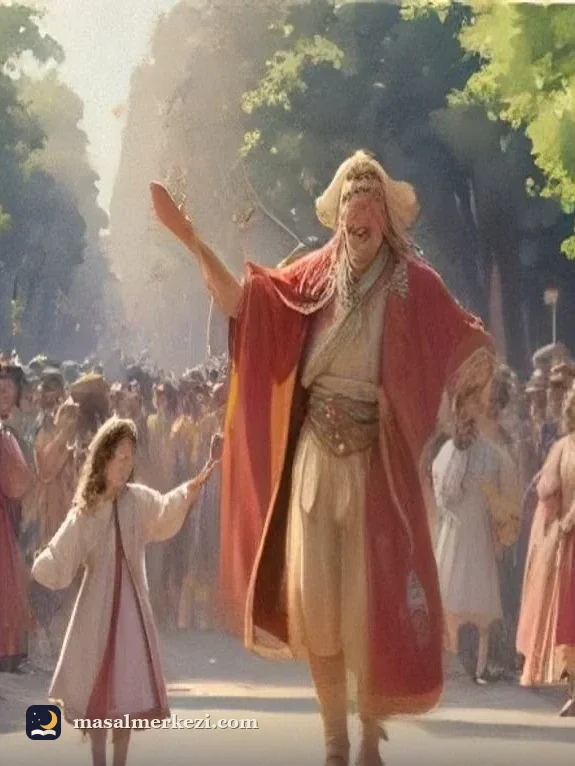
The Snow Queen
When splinters of a wicked mirror get into Kay's eye and heart, the Snow Queen carries him away; little Gerda walks barefoot to the far north to find him.
Tap a word to see it in Turkish · Long press to translate the whole sentence.
THE FIRST STORY: THE MIRROR AND ITS PIECES
Now we are beginning. When we reach the end of this story we shall know more than we know now. Once there was a wicked imp, one of the very worst. One day he was in a splendid mood, because he had made a mirror. This mirror had the power of making everything good and beautiful that was reflected in it shrink almost to nothing, while everything worthless and ugly grew larger and looked even worse. The loveliest landscapes looked like boiled spinach in it, and the best people became ugly or stood on their heads. If someone had a good thought, a grinning face appeared in the mirror, and the imp laughed and laughed at his clever invention.
The other imps who went to his school told everyone that a miracle had been made. They ran all over the world with the mirror, until at last there was not a land or a person left that had not been seen twisted in it. Then they wanted to fly up to the sky to make fun of the angels too. The higher they flew with the mirror, the more it grinned, until they could hardly hold on to it. Higher and higher they flew, until the mirror shook so hard that it slipped from their hands, fell to the earth and broke into hundreds of millions, billions of pieces.
That was when the real trouble began. Some of the splinters were smaller than a grain of sand, and they blew all over the world. Wherever one got into someone's eye it stayed there, and that person began to see everything wrongly, or to see only the bad side of things. Some people got a tiny splinter in their heart, and that heart grew as cold as a lump of ice. The wicked imp laughed until his sides ached. And little splinters of glass are still flying about in the air. Now listen!
THE SECOND STORY: A LITTLE BOY AND A LITTLE GIRL
In a big city, where there are so many houses and people that there is not room enough for everyone to have a little garden, there lived two poor children. They had a garden a little bigger than a flowerpot. They were not brother and sister, but they loved each other as if they were. Their parents lived in the attics of two neighbouring houses. Where the roof of one house ended, the roof of the other began; the gutters of the two houses touched, and from each house a little window looked out. You could step over the gutter from one window to the other.
Outside, their parents had big wooden boxes in which grew the herbs they used in the kitchen, and a little rose bush in each. They placed the boxes across the gutter so that they nearly reached from one window to the other and looked like two flower beds. The peas hung down from the boxes, and the rose bushes put out long branches that twined around the windows. The children sat on their little stools under these roses and played, and how happily they played!
In winter this fun came to an end. The windows froze over. But the children warmed copper coins on the stove and pressed them against the frosty glass, and so they made a lovely round peephole. From each window's peephole a sweet, gentle eye looked out: these were the little boy and the little girl. The boy's name was Kay and the girl's was Gerda. In summer they could reach each other with a single step, but in winter they had to go down a great many stairs and then up a great many stairs. Outside the snow was whirling.
"The white bees are swarming," said the old grandmother. "Do they have a queen too?" asked the little boy, because he knew that real bees have a queen. "They do," said the grandmother. "She flies where the swarm is thickest. She is the biggest of them all and never stays on the ground, but flies back up into the black clouds. On some winter nights she flies through the streets of the town and looks in at the windows, and then the panes freeze in such strange patterns that they look like flowers." "Yes, I've seen that!" said both children, and they knew it was true. "Can the Snow Queen come in here?" asked the little girl. "Just let her come," said the boy, "I'll put her on the hot stove and she'll melt."
In the evening, when little Kay was at home and half undressed, he looked out through the little hole in the window. A few snowflakes were falling outside, and one of them, the biggest, stayed on the edge of the flower box. The snowflake grew and grew, until at last it became a woman dressed in the finest white gauze, woven from millions of star-like flakes. She was very beautiful and graceful, but she was made of ice, dazzling, glittering ice. And yet she was alive. Her eyes shone like two bright stars, but there was neither peace nor rest in them. She nodded towards the window and beckoned with her hand. The little boy was frightened and jumped down from his chair. At that moment it seemed as if a great bird flew past the window.
The next day was clear and frosty. Then came the first days of spring; the sun shone, green shoots came up, the swallows built their nests, the windows were opened, and the two children sat again in their little garden in the gutter on the roof. That summer the roses bloomed more beautifully than ever. The little girl had learned a hymn; there were roses in it, and it made her think of her own roses. She sang it to the little boy, and he sang it with her: "In the valley the roses bloom, and there we speak with the Christ Child." The children held hands, kissed the roses and looked up at God's bright sunshine and talked to it as if the Christ Child were there. What lovely summer days those were!
Kay and Gerda were sitting looking at a picture book full of animals and birds. Just as the big clock in the church tower struck five, Kay suddenly said, "Oh! Something pricked my heart! And something got into my eye!" The little girl threw her arms around his neck; he blinked his eyes, but there was nothing to be seen. "I think it's gone," he said. But it was not gone. It was a splinter from that mirror, that wicked mirror that made everything good and beautiful look small and ugly. And poor Kay had got a splinter in his heart too, and his heart would soon be like a lump of ice. It no longer hurt, but the splinter was there.
"Why are you crying?" asked Kay. "You look so ugly like that! There's nothing wrong with me. Ugh!" he cried suddenly. "That rose has a worm in it. And look, this one is all crooked. They're ugly roses, really! Just like the boxes they stand in!" Then he kicked the box and tore off two roses. "Kay, what are you doing?" cried the little girl. When he saw that she was frightened, he tore off another rose and ran in at his own window, leaving little Gerda behind.
Later, when she brought the picture book, he said it was for babies. When the grandmother told stories, he always found a "but". Whenever he could, he walked behind the grandmother, put on her spectacles and talked like her. He did it so well that people laughed. Soon he could imitate the way everyone in the street talked and walked. Whatever was odd or unpleasant about them, Kay imitated. He did these things because of the splinter in his eye and the piece of glass in his heart. He even made fun of little Gerda, who loved him with all her heart.
His games became quite different too, very clever games. One winter's day, when the snowflakes were whirling, he brought a big magnifying glass, held out the tail of his blue coat and let the snowflakes fall on it. "Look through the glass, Gerda!" he said. Every snowflake looked much bigger and was like a splendid flower or a ten-pointed star. It was lovely to look at. "See how clever it is?" said Kay. "It's much more interesting than real flowers. There isn't a single flaw in them. If only they didn't melt they would be perfect."
A little while later Kay came with his big gloves on and his sledge on his back and shouted in Gerda's ear: "I've been allowed to go sledging in the big square with the other boys!" and off he went. In the square the boldest boys would tie their sledges to the farmers' carts and ride along with them for a while. It was great fun. In the middle of the game a big sledge came along. It was painted white all over, and in it sat someone wrapped in a thick white fur and wearing a white fur cap. The sledge drove twice around the square, and Kay quickly tied his little sledge to it and went along with it.
The sledge went faster and faster and turned straight into the next street. The person driving it turned and gave Kay a friendly nod, as if they knew each other. Whenever Kay wanted to untie his sledge, the person nodded again and Kay stayed where he was. They drove out through the city gates. The snow began to fall so thickly that the little boy could not see in front of him. Quickly he untied the rope, but it was no use; his little sledge was fastened tight to the big one, and they flew like the wind. He shouted at the top of his voice, but nobody heard. The snow fell and the sledge flew. Now and then it gave a jump, as if it were going over hedges and ditches. The boy was very frightened; he wanted to say his prayers, but all he could remember was his multiplication table.
The snowflakes grew bigger and bigger, until at last they looked like great white hens. Suddenly they sprang aside; the big sledge stopped, and the person who drove it stood up. The fur and the cap were made of snow. It was a lady, tall and slender and dazzling white. It was the Snow Queen. "We have travelled fast," she said, "but it won't do to freeze here. Come, creep inside my bearskin." She set him in her own sledge beside her and wrapped her fur around him. To Kay it felt as if he were sinking into a snowdrift.
"Are you still cold?" asked the Snow Queen, and she kissed his forehead. Oh! That kiss was colder than ice. It went straight to his heart, which was already half a lump of ice. For a moment he felt as if he were going to die, but only for a moment. Then he felt quite well and no longer noticed the cold around him. "My sledge! Don't forget my sledge!" That was the first thing he thought of. They tied the sledge to one of the white hens, and it flew along behind them with the sledge. The Snow Queen kissed Kay once more, and then he forgot little Gerda and the grandmother and everyone at home. "Now I won't kiss you any more," said the Snow Queen, "or I would kiss you to death."
Kay looked at her. She was very beautiful. He could not imagine a wiser or lovelier face. She no longer seemed made of ice, as she had when she beckoned to him through the window. In Kay's eyes she was perfect, and he was not at all afraid of her. He told her that he could do sums with fractions, and that he knew how many square miles every country had and how many people lived there. And the Snow Queen just smiled. Then Kay thought that perhaps he did not know so very much after all. He looked up into the wide sky. The Snow Queen flew with him high up above the black clouds. The storm whistled and roared, as if it were singing old songs. They flew over forests and lakes, over seas and lands. Below them the cold wind howled, the wolves howled, the snow glittered. Above them flew black, screeching crows. But above everything the moon shone, large and bright. Kay gazed at it through the long winter night. When day came he slept at the Snow Queen's feet.
THE THIRD STORY: THE FLOWER GARDEN OF THE WOMAN WHO KNEW MAGIC
What did little Gerda do when Kay never came back? Where could Kay be? Nobody knew, nobody could say. The boys could only tell that they had seen him tie his little sledge to a big, fine one, which had driven into the street and out through the city gate. Nobody knew where he had gone. Many tears were shed, and little Gerda cried long and bitterly. Then people said that Kay was dead, that he had drowned in the river that flowed near the town. Oh, what long, dark winter days those were!
At last spring came and the sun shone warmer. "Kay is dead and gone," said little Gerda. "I don't believe it," said the sunshine. "Kay is dead and gone," she said to the swallows. "We don't believe it," they said. And at last little Gerda did not believe it either. One morning she said, "I'll put on my new red shoes, the ones Kay has never seen. Then I'll go down to the river and ask it about Kay."
It was very early. She kissed her sleeping grandmother, put on her red shoes and went all alone out through the city gate and down to the river. "Is it true that you took my little playmate?" she asked the river. "If you give him back to me, I'll give you my red shoes." It seemed to her that the waves nodded strangely. So she took off her red shoes, the thing she loved most, and threw them both into the river. But they fell close to the bank, and the little waves carried them straight back to her. It was as if the river did not want to take the thing she loved most, because it did not have little Kay. But Gerda thought she had not thrown the shoes far enough. She climbed into a boat that lay among the reeds, went to the far end of it and threw the shoes again. The boat was not tied up, and with her movement it slid away from the bank. She noticed and tried to get out quickly, but before she could reach the other end the boat was a metre from the bank and drifting away faster and faster.
Little Gerda was very frightened and began to cry. But nobody heard her except the sparrows, and they could not carry her to land. They flew along the bank and chirped, as if they wanted to comfort her: "Here we are! Here we are!" The boat drifted with the current. Little Gerda sat quite still in her stockings; her red shoes floated behind, but they could not catch up with the boat, because it went faster.
Both banks of the river were very beautiful. There were lovely flowers, old trees, and sheep and cows on the slopes, but not a single person. "Perhaps the river is taking me to little Kay," thought Gerda, and that cheered her up. She stood up and looked at the beautiful green banks for hours. At last the boat came to a big cherry orchard. In the orchard there was a little house with strange red and blue windows and a thatched roof, and at the door stood two wooden soldiers who presented arms to anyone who passed.
Gerda called to them, thinking they were alive, but of course they did not answer. The boat came close to the bank. Gerda called even louder, and out of the house came a very, very old woman. She leaned on a stick and wore a big sun hat painted with lovely flowers. "You poor little child!" said the old woman. "How did you get onto this great, strong river and come so far out into the world?" Then she waded into the water, caught hold of the boat with her stick, pulled it to the bank and lifted little Gerda out.
Gerda was glad to be on dry land again, but she was a little afraid of the strange old woman. "Come and tell me who you are and how you came here," said the woman. Gerda told her everything, and the old woman shook her head and said, "Hm! Hm!" When Gerda had told her everything, she asked whether she had seen little Kay. The woman said he had not passed that way, but that he would surely come; Gerda must not be sad, but eat her cherries and look at her flowers, which were prettier than any picture book and could each tell a story. Then she took Gerda by the hand, led her into the little house and locked the door.
The windows were very high up, and their panes were red, blue and yellow. The daylight shone in in strange colours. On the table stood the most delicious cherries. Gerda ate as many as she liked, because she was allowed to. While she ate, the old woman combed her hair with a golden comb. The girl's yellow hair shone in curls around her sweet little face, which was as round as a rose. "I've always wanted a dear little girl like you," said the old woman. "You'll see how well we'll get on together." The more the woman combed little Gerda's hair, the more Gerda forgot her playmate Kay, because the old woman could do magic. But she was not a wicked witch; she only did a little magic for her own pleasure, and she wanted to keep little Gerda with her.
So she went into the garden and pointed her stick at all the rose bushes, and however beautifully they were blooming, they all sank down into the black earth, and no one could see where they had stood. The old woman was afraid that if Gerda saw the roses she would remember her own roses, and then little Kay, and run away. Then she took Gerda into the flower garden. Oh, how sweet it smelled and how beautiful it was! Every flower you could think of, flowers of every season, stood there in full bloom. No picture book could be so bright and lovely. Gerda jumped for joy and played until the sun went down behind the tall cherry trees. Then she slept in a lovely bed with red silk pillows embroidered with violets, and she dreamed as sweetly as a queen.
The next day she played again with the flowers in the warm sunshine, and so many days went by. Gerda knew every flower. But however many there were, she felt that one was missing, though she did not know which. One day she sat looking at the old woman's sun hat painted with flowers, and the loveliest of them was a rose. The old woman had forgotten it when she sent the other roses into the ground. You can't always remember everything! "What!" said Gerda. "Are there no roses here?" She ran among the beds and searched and searched, but she could not find any. She sat down and cried. Her hot tears fell just where a rose bush had sunk. When the tears watered the earth, the bush suddenly came up out of the ground, blooming just as it had been when it sank. Gerda hugged it, kissed the roses and thought of the beautiful roses at home, and with them, of little Kay.
"Oh, how long I've stayed!" said the little girl. "I should have been looking for Kay! Don't you know where he is?" she asked the roses. "Do you think he is dead and gone?" "He is not dead," said the roses. "We have been under the ground. All the dead are there, but Kay was not." "Thank you!" said little Gerda. Then she went to the other flowers, looked into their cups and asked: "Do you know where little Kay is?" But each flower stood in the sun dreaming its own fairy tale or story. Gerda heard many stories from them, but none of them knew anything about Kay.
The tiger lily told the story of its tower, the bluebells the story of their bells, the hyacinth told of three lovely sisters, the buttercup of an old grandmother's spring day, and the narcissus of a little dancer looking at herself in a mirror. "That's nothing to do with me!" said Gerda. She ran to the end of the garden. The gate was locked, but she shook the rusty latch until it gave way and the gate swung open. Little Gerda ran out barefoot into the wide world. She looked back three times, but nobody followed her. At last she could run no more and sat down on a big stone. When she looked around, she saw that summer was over; it was late autumn. She had not noticed it in the lovely garden, where the sun always shone and the flowers of every season bloomed.
"Goodness, how late I am!" said little Gerda. "Autumn has come! I can't rest now!" And she set off. Oh, how tired and sore her little feet were! Everything around her was cold and bleak. The long willow leaves had turned yellow, and drops fell from the mist. The leaves dropped one by one. Only the sloe bush still had fruit, but it was so sour it made her mouth pucker. Oh, how grey and gloomy the wide world was!
THE FOURTH STORY: THE PRINCE AND THE PRINCESS
Gerda had to rest again. Right opposite where she sat, a big crow was hopping in the snow. He had sat looking at her for a long time, nodding his head, and at last he spoke: "Caw! Caw! Hello! Hello!" He could not say it any better, but he meant well towards the little girl and asked where she was going all alone in the wide world. Gerda understood the word "alone" very well and felt what it meant. She told the crow her whole life and asked if he had seen Kay.
The crow nodded thoughtfully and said, "Maybe! Maybe!" "What? Really?" cried the little girl, and she kissed the crow so hard she nearly squeezed him to death. "Gently, gently!" said the crow. "I think it may be Kay, but by now he has probably forgotten you for the princess." "Does he live with a princess?" asked Gerda. "Yes, listen," said the crow. "In the kingdom where we are now there lives a princess who is very clever. She has read all the newspapers in the world and forgotten them again, that's how clever she is. The other day she was sitting on her throne, and that's not much fun, they say. She began to hum a song that went, 'Why shouldn't I marry?' 'There's something in that,' she said, and she decided to marry. But she wanted a husband who could answer when he was spoken to, not one who just stood and looked grand, because that is so dull."
The crow went on: the newspapers at once announced that every good-looking young man might come to the palace and talk with the princess, and the one who talked most easily and best would be her husband. People came in crowds, there was pushing and shoving, but nothing came of it, neither on the first day nor on the second. They all talked well enough in the street, but when they came through the palace gate and saw the guards in silver and the footmen in gold on the stairs and the great lighted halls, they were dumbstruck. And when they stood before the throne where the princess sat, all they could do was repeat the last word she had said.
"But Kay, little Kay?" asked Gerda. "When did he come? Was he in the crowd?" "Wait! Wait! We're just coming to him. On the third day a little person came, without horse or carriage, and marched cheerfully straight up to the palace. His eyes shone like yours, he had lovely long hair, but his clothes were poor." "That was Kay!" cried Gerda with joy. "He had a little knapsack on his back," said the crow. "No, that must have been his sledge," said Gerda, "because he went away with his sledge." "It may be," said the crow, "I didn't look very carefully. But I know from my sweetheart, who lives in the palace, that when he came through the palace gate and saw the guards in silver and the footmen on the stairs, he wasn't the least bit dismayed; he nodded and said, 'It must be dull standing on the stairs, I'll go inside.' The halls were blazing with light, but he wasn't afraid. His boots squeaked terribly, but still he wasn't afraid."
"That's Kay for sure!" said Gerda. "He had new boots; I heard them squeaking in grandmother's room." "Yes, they squeaked," said the crow. "He went straight up to the princess. She was sitting on a pearl as big as a spinning wheel. The boy told the princess he hadn't come to marry her but to hear her wisdom. He liked her wisdom, and she liked his." "Yes, that's certainly Kay!" said Gerda. "He was so clever. He could do sums with fractions. Oh, won't you take me to the palace?"
The crow talked it over with his sweetheart, and when night fell they led Gerda through the back door of the palace and up the back stairs. The girl's heart was beating with fear and longing, as if she were doing something wrong. And yet she only wanted to know whether little Kay was there. It must be him! She pictured his clever eyes and his long hair. She could almost see him smiling, as he used to when they sat under the roses at home. He would surely be glad when he saw her, when he heard how long a road she had walked, when he heard how sad everyone at home had been when he did not come back.
At last they reached the bedroom. The ceiling looked like a palm tree with leaves of glass, precious glass. In the middle of the room two beds hung from a thick golden stalk, and each looked like a lily. One was white, and in it lay the princess. The other was red, and in it Gerda hoped to find little Kay. She drew aside one of the red petals and saw a brown neck. Oh, it was Kay! She called his name aloud and held the lamp towards him. The sleeping young man woke, turned his head, and... it was not little Kay!
The prince was only like him at the back of the neck, but he was young and handsome. The princess looked out from her white lily bed too and asked what was the matter. Little Gerda began to cry and told her whole story and all that the crows had done for her. "Poor little thing!" said the prince and the princess. They praised the crows and said they were not angry with them, but they must not do it again. As a reward the crows were made court crows.
The prince got out of his own bed and let Gerda sleep in it. He could not do more. She folded her little hands and thought, "How kind people and animals are!" She closed her eyes and slept sweetly. The next day they dressed her from head to foot in silk and velvet. They invited her to stay at the palace and have a lovely time. But Gerda asked only for a little carriage, a horse to pull it and a pair of boots; she would go out again into the wide world to look for Kay.
They gave her both boots and a muff. They dressed her beautifully, and when she was ready to leave, a new carriage of pure gold stood at the door; the coat of arms of the prince and princess shone on it like a star. The coachman, the footmen and the outriders, for there were outriders too, sat with golden crowns on their heads. The prince and princess helped her into the carriage and wished her good luck. The forest crow came with her for the first three miles. He sat beside her in the carriage, because he could not bear riding backwards. Inside the carriage there were sugar plums and biscuits, and under the seat fruit and gingerbread. "Farewell! Farewell!" cried the prince and princess, and little Gerda cried, and the crow cried too.
THE FIFTH STORY: THE LITTLE ROBBER GIRL
They were driving through a dark forest, but the carriage shone like a torch. It dazzled the robbers' eyes, and they could not bear it. "Gold! Gold!" they shouted. They rushed out, seized the horses, chased away the little outriders, the coachman and the footmen, and pulled little Gerda out of the carriage. "How plump and pretty she is! Fed on nuts!" said the old robber woman. She had a long, bristly beard and eyebrows that hung down over her eyes.
Just then her little daughter, who was hanging on her back, bit her ear. This girl was very wild and naughty. "She shall play with me!" said the little robber girl. "She shall give me her muff and her pretty dress and sleep with me in my bed!" The little robber girl was as big as Gerda but stronger, broader in the shoulders and darker of skin. Her eyes were quite black and looked almost sad. She put her arm around little Gerda's waist and said, "As long as I'm not cross with you, nobody shall do anything to you. Are you a princess?" "No," said little Gerda, and she told her all that had happened to her and how much she loved little Kay.
The robber girl looked at her seriously, nodded a little and said, "Even if I am cross with you, nobody shall do anything to you; I'll do it myself then." Then she dried Gerda's eyes and put both her hands into the soft, warm muff. The carriage stopped. They were in the courtyard of a robbers' castle. Its walls were cracked from top to bottom. Ravens and crows flew in and out of the cracks. Big dogs, each looking as if it could swallow a person, leapt high in the air, but they did not bark, because barking was forbidden.
In the middle of the great, old, smoky hall a big fire was burning on the stone floor. The smoke rose to the ceiling and looked for a way out. Soup was boiling in a big cauldron, and hares were turning on spits. "Tonight you shall sleep with me and all my little animals," said the robber girl. They had something to eat and drink and went to a corner where straw and rugs were spread. Above them, on laths and perches, sat nearly a hundred pigeons. They all seemed to be asleep, but they stirred a little when the little girls came.
"These are all mine," said the little robber girl. "And these are wood pigeons, two of them," she went on, pointing to some bars in front of a hole in the wall. "They always fly away, so they have to be locked up. And here is my dear old reindeer." She pulled a reindeer by the antler; it had a bright copper ring around its neck and was tied up. "We have to keep him tight too, or he'd run away."
"Are you going to sleep here?" asked Gerda. "I always sleep with my knife beside me," said the robber girl. "In the forest you never know what may happen. But now tell me again what you told me before about little Kay, and why you went out into the wide world." Gerda told it all from the beginning. The wood pigeons cooed up in their cage; the other pigeons slept. The little robber girl put one arm around Gerda's neck, held her knife in the other hand and fell asleep. But Gerda could not close her eyes; she did not know whether she would live or die.
Then the wood pigeons said: "Coo! Coo! We have seen little Kay. A white hen was carrying his sledge; he was sitting in the Snow Queen's sledge. It passed low over the forest while we were in our nest. The Queen breathed on us young ones, and all of them died except us two. Coo! Coo!" "What are you saying up there?" cried Gerda. "Where was the Snow Queen going? Do you know anything?" "She was probably going to Lapland, because there is always snow and ice there. Ask the reindeer, he knows." "There's snow and ice there; it's a glorious, beautiful place!" said the reindeer. "There you run free in great shining valleys! The Snow Queen has her summer tent there, but her real castle is up towards the North Pole, on the island called Spitsbergen."
"Oh Kay, little Kay!" sighed Gerda. "Lie still!" said the robber girl. "Or I'll tickle you till morning!" In the morning Gerda told her what the wood pigeons had said. The little robber girl looked very serious, nodded her head and said, "Never mind! Never mind!" "Do you know where Lapland is?" she asked the reindeer. "Who should know better than I?" said the reindeer, and his eyes shone. "I was born and bred there; I ran there on the snowy plains."
"Listen!" said the robber girl to Gerda. "You see that all the men have gone. Only my mother is here, and she's staying. But towards noon she drinks from the big bottle and then has a little nap; then I'll do something for you." When her mother had drunk from the big bottle and fallen asleep, the robber girl went to the reindeer and said: "I'd like to keep you here, because you're such a funny animal. But never mind. I'm going to untie you and let you out so you can run to Lapland. But you must use your legs well and take this little girl to the Snow Queen's castle; her playmate is there. You heard what she told me, because she talked loud enough and you're always eavesdropping."
The reindeer leapt high for joy. The robber girl lifted little Gerda onto his back and tied her on firmly, and even gave her a little cushion to sit on. "Never mind," she said, "here are your fur boots, because it's going to be cold. But I'll keep the muff, it's too pretty. Still, you won't be cold. Here are my mother's big mittens; they come right up to your elbows. Put them on! Now your hands look just like my ugly mother's." Gerda cried for joy. "I can't stand your snivelling," said the little robber girl. "Now you ought to look really happy. Here are two loaves and a ham, so you won't go hungry."
She tied them both onto the reindeer's back. The little robber girl opened the door, called all the big dogs inside, then cut the rope with her knife and said to the reindeer, "Now run! But take good care of the little girl!" Gerda held out her hands in the big mittens to the robber girl and said goodbye. The reindeer ran as fast as he could, over bushes and stumps, through the great forest, over marshes and moors. The wolves howled and the ravens screamed. The sky seemed to be flashing with fire. "Those are my dear old northern lights!" said the reindeer. "See how they shine!" Then he ran even faster, night and day. The loaves were eaten, and the ham too, and at last they reached Lapland.
THE SIXTH STORY: THE LAPP WOMAN AND THE FINN WOMAN
They stopped in front of a little hut; it was a very poor hut. The roof came down to the ground, and the door was so low that the family had to crawl on their stomachs to go in or out. There was nobody at home but an old Lapp woman. She was frying fish over a whale-oil lamp. The reindeer told her Gerda's whole story, but first his own, because he thought it was much more important. And Gerda was so numb with cold that she could not speak.
"Oh, you poor things!" said the Lapp woman. "You still have a very long way to go! You must go hundreds of miles more, to Finnmark. The Snow Queen is staying there in her country house, and every evening she lights blue fireworks. I'll write a few words on a dried codfish, because I have no paper. Take it to the Finn woman there; she can tell you more than I can." When Gerda had warmed herself and had something to eat and drink, the Lapp woman wrote a few words on a dried codfish, told Gerda to take good care of it, tied her onto the reindeer again, and off he ran. All night long the most beautiful blue northern lights shone. Then they came to Finnmark and knocked on the Finn woman's chimney, because she did not even have a door.
Inside it was so hot that the Finn woman went about with hardly any clothes on. She was small and rather dirty. At once she took off little Gerda's clothes, mittens and boots, or the girl would have been too hot. She put a piece of ice on the reindeer's head and then read what was written on the codfish. She read it three times, until she knew it by heart, and then she put the fish into the soup pot, because it could be eaten and she never wasted anything.
Then the reindeer told first his own story and then little Gerda's, and the Finn woman blinked her wise eyes but said nothing. "You are very wise," said the reindeer. "I know you can tie all the winds of the world with a thread. If a sailor unties one knot he gets a good wind; if he unties the second it blows hard; and if he unties the third and fourth, a storm breaks out that blows down the forests. Won't you give this little girl a drink that will give her the strength of twelve men, so she can overcome the Snow Queen?" "The strength of twelve men?" said the Finn woman. "Much good that would do!"
The Finn woman went to a shelf, took down a big rolled-up skin and unrolled it. Strange letters were written on it. The Finn woman read and read until the sweat ran down her forehead. The reindeer begged so hard for little Gerda, and Gerda looked at the Finn woman with such pleading, tearful eyes, that the woman began to blink again. She drew the reindeer into a corner and, while she put fresh ice on his head, she whispered:
"Little Kay is indeed with the Snow Queen. He likes everything there and thinks it is the best place in the world. But that is because he has a splinter of glass in his heart and a tiny grain of glass in his eye. They must come out first, or he will never be human again, and the Snow Queen will keep her power over him." "But can't you give little Gerda something to give her power over all that?" "I can't give her greater power than she already has! Don't you see how great it is? Don't you see how people and animals have to serve her, how far she has come in the world on her bare feet? She does not need to learn her power from us; her power is in her heart, in being a sweet, innocent child. If she cannot reach the Snow Queen herself and take the glass out of little Kay, we cannot help her! Two miles from here the Snow Queen's garden begins. You can carry the little girl there. Put her down by the big bush with red berries that stands in the snow. Don't stand there chattering; hurry and come back here!"
Then the Finn woman lifted little Gerda onto the reindeer, and he ran as fast as he could. "Oh, I haven't got my boots! I haven't got my mittens!" cried little Gerda. She noticed it in the biting cold. But the reindeer did not dare to stop; he ran all the way to the big bush with the red berries. There he set Gerda down, kissed her on the mouth, and big, shining tears ran down the reindeer's cheeks. Then he ran back as fast as he could. And there stood poor Gerda, without boots, without mittens, in the middle of terrible, ice-cold Finnmark.
She ran forward as fast as she could. A whole army of snowflakes came, but they did not fall from the sky; the sky was quite clear and shining with the northern lights. The snowflakes ran along the ground, and the closer they came, the bigger they grew. Gerda remembered how big and beautiful the snowflakes had looked through the magnifying glass. But these were even bigger and more terrible. They were alive; they were the Snow Queen's guards. They had the strangest shapes: some looked like big, ugly hedgehogs, some like knots of snakes with their heads raised, and some like little fat bears with their hair standing on end. All of them were dazzling white, all of them living snowflakes.
Then little Gerda said her prayers. The cold was so great that she could see her own breath; it came out of her mouth like smoke. Her breath grew thicker and thicker and turned into little bright angels, who grew bigger as they touched the ground. All of them had helmets on their heads and spears and shields in their hands. There were more and more of them, and when Gerda had finished her prayer there was a whole army around her. They struck at the dreadful snowflakes with their spears, and the snowflakes broke into hundreds of pieces. Little Gerda walked on safely and bravely. The angels stroked her hands and feet, and she felt the cold less. Quickly she walked towards the Snow Queen's castle.
But now let us first see what Kay was doing. He was not thinking of little Gerda at all, and least of all that she was standing outside the castle.
THE SEVENTH STORY: WHAT HAPPENED IN THE SNOW QUEEN'S CASTLE, AND WHAT HAPPENED AFTERWARDS
The walls of the castle were made of drifting snow, and the windows and doors of cutting winds. There were more than a hundred halls, stretching just as the snow had drifted. The biggest stretched for many miles. All were lit by the bright northern lights, and they were so big, so empty, so icy cold and so glittering! There was never any fun here, not even a little ball where the bears could dance in the storm and stand on their hind legs and show their fine manners. The white foxes never held a tea party. The Snow Queen's halls were empty, vast and cold.
In the middle of this empty, endless hall of snow there was a frozen lake. It was cracked into a thousand pieces, but each piece was so exactly like the others that it was a perfect work of art. When the Snow Queen was at home she sat in the middle of this lake, and she called it the Mirror of Reason; she said it was the only and the best mirror in the world.
Little Kay was quite blue with cold, almost black, but he did not notice it, because the Snow Queen had kissed away his shivering, and his heart was like a lump of ice. He was dragging some sharp, flat pieces of ice about. He kept putting them together in every way, trying to make something of them, just as we make pictures with little pieces of wood in the game we call a Chinese puzzle. Kay was making figures too, the most clever figures. This was the Ice Puzzle of Reason. In his eyes these figures were wonderful and very important; that was because of the grain of glass in his eye. He made whole figures that spelled a word, but he could never manage to make the word he wanted. That word was "ETERNITY". The Snow Queen had said, "If you can find that figure, you shall be your own master, and I will give you the whole world and a new pair of skates." But he could not do it.
"Now I'm going to fly to the warm countries," said the Snow Queen. "I'll go and look into the black pots." By that she meant the fire-spitting mountains, Etna and Vesuvius. "I'll whiten them a little. That does them good, and the lemons and grapes too." The Snow Queen flew away, and Kay sat all alone in the great, empty hall of ice that stretched for miles. He looked at the pieces of ice and thought and thought until something creaked inside him. He sat quite stiff and still; you would have thought he had frozen to death.
It was then that little Gerda came into the castle through the great gate. Cutting winds were blowing, but Gerda said her evening prayer, and the winds lay down as if they wanted to sleep. She went into the great, empty, cold halls and saw Kay. She knew him, flew to throw her arms around his neck, held him tight and cried: "Kay! Dear little Kay! I've found you at last!" But Kay sat stiff, cold and still. Then little Gerda wept hot tears. They fell on Kay's breast, went all the way to his heart, melted the lump of ice and washed away the little splinter of mirror inside it.
Kay looked at her, and Gerda sang the hymn: "In the valley the roses bloom, and there we speak with the Christ Child." Then Kay burst into tears. He cried so hard that the grain of glass ran out of his eye. He knew her and cried with joy: "Gerda! Dear little Gerda! Where have you been all this time? And where have I been?" He looked around him. "How cold it is here! How big and empty!" He held on to Gerda, and she laughed and cried for joy. It was so lovely that even the pieces of ice danced with joy. When they were tired they lay down, and they formed exactly the letters that the Snow Queen had said Kay must find to become his own master and get the whole world and a new pair of skates.
Gerda kissed his cheeks, and they bloomed like flowers. She kissed his eyes, and they shone like hers. She kissed his hands and feet, and he was healthy and strong. The Snow Queen could come home now if she liked; Kay's letter of freedom stood written there in glittering letters of ice.
They took each other by the hand and walked out of the great castle. They talked about the grandmother and the roses on the roof. Wherever they went, the winds were still and the sun came out. When they reached the bush with the red berries, the reindeer was waiting there. He had brought a young reindeer with him; her udder was full, and she gave the children warm milk and kissed them on the mouth. Then they carried Kay and Gerda first to the Finn woman. They warmed themselves in her hot room and learned the way home. Then they went to the Lapp woman; she sewed them new clothes and got her sledge ready.
The reindeer and the young reindeer ran beside them and went with them to the border of the country. There the first green shoots were coming up from the earth. There they said goodbye to the reindeer and the Lapp woman. "Farewell!" they all said to each other. And the first little birds began to twitter, and there were green buds in the forest. Out of the forest came a young girl riding a fine horse. Gerda knew the horse, because it was the one that had pulled her golden carriage. The girl wore a bright red cap on her head and had pistols in her belt. It was the little robber girl. She had got tired of staying at home and wanted to go first to the north and then wherever else she liked.
She knew Gerda at once, and Gerda knew her. What joy that was! "You're a fine one for wandering about!" she said to little Kay. "I'd like to know if you're worth someone running to the end of the world for!" But Gerda patted her cheek and asked about the prince and princess. "They've gone to foreign lands," said the robber girl. "And the crow?" asked little Gerda. "The crow is dead," she said. "His tame sweetheart is a widow and goes about with a bit of black wool tied round her leg. She cries most pitifully, but it's all nonsense! Now tell me what you've been doing, and how you found him." Gerda and Kay both told her together.
"Snip-snap-snurre-basselurre!" said the robber girl. She shook hands with both of them and promised that if she ever passed through their town she would come and visit them. Then she rode away into the wide world. Kay and Gerda walked hand in hand. As they walked, a lovely spring with flowers and green grass spread all around them. Church bells were ringing, and they knew the high towers and the big town. It was the town where they lived. They went into the town, to the grandmother's door, up the stairs and into the room. There everything stood just where it had been before. The clock said "tick, tock" and the hands went round. But as they went through the door they noticed that they had grown up and become grown-ups.
The roses in the gutter were hanging in at the open windows, and there stood the little children's stools. Kay and Gerda sat down on their own stools and held each other's hands. They had forgotten the cold, empty splendour of the Snow Queen like a heavy dream. The grandmother sat in God's bright sunshine, reading aloud from the Bible: "Unless you become as little children, you shall not enter the Kingdom of Heaven." Kay and Gerda looked into each other's eyes, and all at once they understood the old hymn: "In the valley the roses bloom, and there we speak with the Christ Child." And there they both sat, grown up and yet children, children at heart. And it was summer, warm, blessed summer.
The tale ends here. Sleep well.
The Snow Queen is a children's tale from Hans Christian Andersen, suitable for ages 7-12 and about 43 minutes long. Read it free on Masal Merkezi, play a lullaby or nature sound in the background, tap any word to see its Turkish meaning and save it to your favorites. For similar tales browse the Andersen Fairy Tales category.
Sign up and your favorites and reading list follow you on every device.